
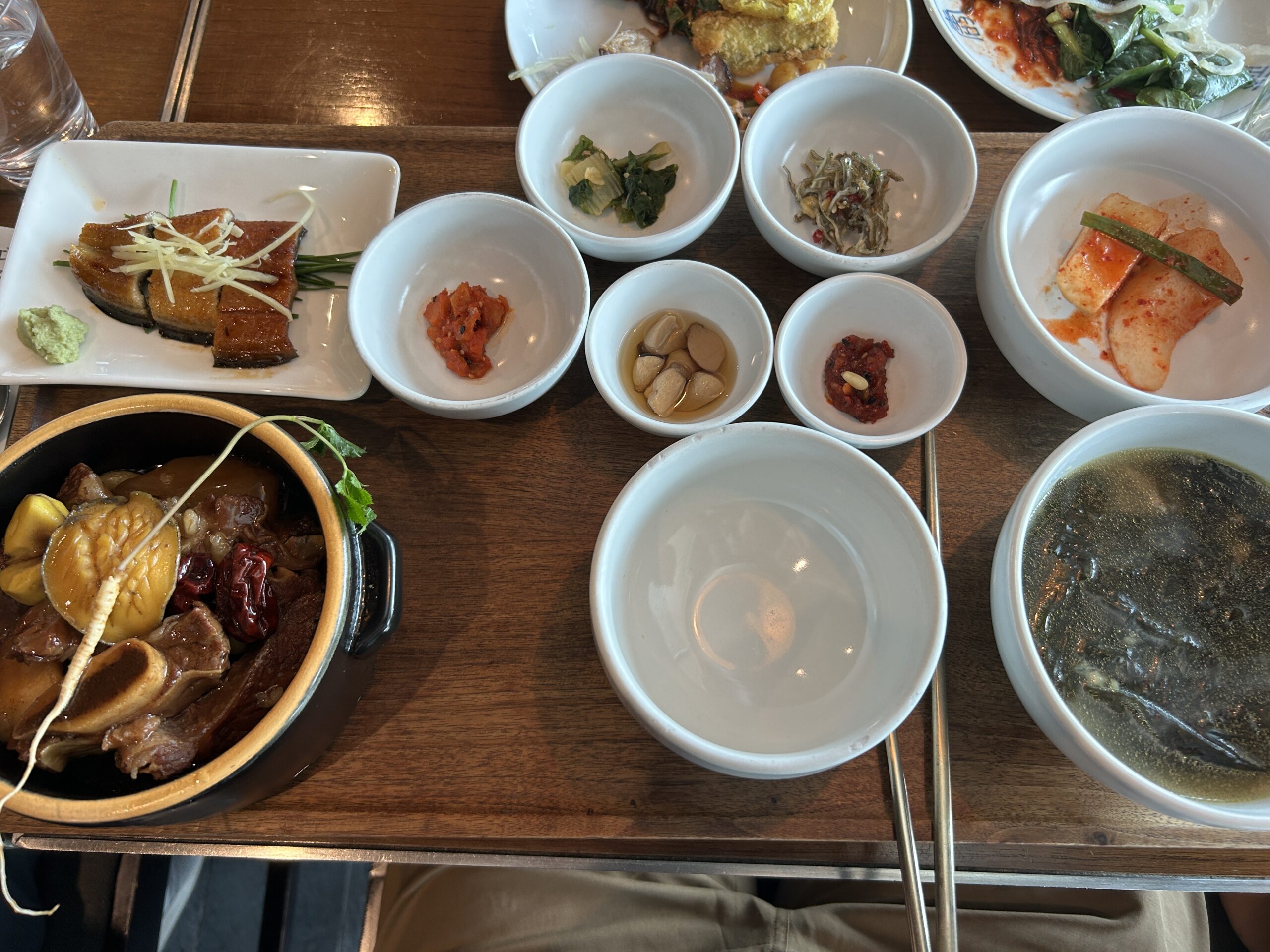
This is my Korean food bucket list — the mental checklist I’ve been working through on every Korea visit since moving to New Zealand over ten years ago. Two trips back in recent years: 2022 and 2024. Same list, same logic. The food density, the price points, and the specific things you can’t replicate anywhere else keep pulling me back to the same spots.
I love New Zealand. But there’s a specific kind of hunger that builds up when you’ve been away from Korea for a while — not just for the food itself, but for the density of it. Every street has ten good restaurants. Convenience stores have hot food at 11pm. A decent bowl of something costs less than a flat white.
In 2022, I came back after a four-year gap. I gained over 4kg in a month and couldn’t bring myself to feel bad about it. In 2024, I ran occasionally and tried to eat one light meal per day. Result: 2–3kg. I’m calling that progress.
Here’s what’s on the list.
Quick Answer: Korean Foods Worth Flying Back For
The non-negotiables, in order of frequency:
- Budget café iced americano — ₩1,500–1,800 (~NZ$1.75–2.10 / ~US$1.00–1.20). Nothing in NZ comes close for the price.
- Tteokbokki + sundae + hotdog from a street stall — the classic combo
- Sulbing shaved ice — injeolmi or mango, either way
- Myeongdong Gyoja dumplings — the original, queue-worthy
- Jjimjilbang eggs — nowhere else on earth tastes the same
- Korean fried chicken — not what you think you know
The Daily Korean Food Ritual: The ₩1,800 Iced Americano
The thing I miss most consistently isn’t a restaurant dish. It’s the franchise café iced americano.
In Christchurch, a takeaway coffee costs NZ$5–7. In Korea, budget café chains (Mega Coffee, Compose Coffee, and their many cousins) serve a solid iced americano for ₩1,500–1,800 — roughly NZ$1.75–2.10 / US$1.00–1.20 (April 2026 rates). Every single day of both trips, I had at least one. Some days, two.
Worth noting: Compose Coffee raised its iced americano from ₩1,500 to ₩1,800 in early 2025 — their first price increase in a decade, driven by rising coffee bean costs. It’s still an absurdly good deal by any international standard. Mega Coffee remains at ₩1,500–2,000 depending on size.
If you’re visiting Korea and haven’t yet found a budget café chain, do it within your first hour. It will recalibrate your expectations for everything that follows.
Korean Convenience Store Food: Everywhere, Open 24 Hours, Actually Good

The first thing to understand about Korean convenience stores: there are an extraordinary number of them. GS25, CU, 7-Eleven, Emart24, Ministop — often two or three within a single city block, all open 24 hours, all stocked with far more than chips and drinks. Korea has one of the highest convenience store densities in the world, and the food quality justifies why they’re embedded into daily life the way they are.
Our kids visited one almost every single day during both Korea trips. Not because we were short on options — because they genuinely wanted to. It became a daily ritual: after dinner, before heading back, a convenience store stop to pick up something for the walk or for the room.
The hot food counter rotates through fried chicken pieces, fish cakes on sticks, steamed buns, and corn dogs. The chilled section has triangle kimbap, instant ramen you eat on-site, and enough flavoured milk to fill a swimming pool. The instant cup noodle selection alone could keep you busy for a week. Dosirak lunchboxes (full bento-style meals) average ₩5,500 as of April 2026 — a complete lunch for less than a NZ$7.
The drinks section deserves its own paragraph. The kids went straight for these on every visit.
Banana milk — the Binggrae yellow carton, unchanged since 1974. Not sickly sweet. Just right. It’s the first thing many overseas Koreans reach for when they land. Around ₩1,500–2,000 (~NZ$1.75–2.30 / ~US$1.00–1.35).
Flavoured yogurt drinks — small Yakult-style bottles and the slightly larger Maeil or Binggrae yogurt drinks. Less sweet than Western yogurt, more tart, genuinely refreshing. Buy a few cold.
PB (private brand) products — GS25, CU, and 7-Eleven each have exclusive private label snacks, drinks, and seasonal items you can’t buy anywhere else. The experience of picking up something unrecognisable and trying it is part of the trip. The worst outcome is ₩1,500 wasted. The best outcome is something you’ll spend months trying to find online when you get home.
The best convenience store meal assembled properly costs around ₩5,000–6,000 (~NZ$5.80–7.00 / ~US$3.40–4.10) — hot snack, drink, triangle kimbap. If you’re travelling Korea on a tight budget, you won’t feel like you’re compromising on anything.
Korean Street Food: Tteokbokki, Sundae, Hotdog
New Zealand has never produced a truly satisfying street snack. Korea, meanwhile, has perfected the form over centuries.
The holy trinity I return to every trip:
Tteokbokki — chewy rice cakes in a spicy-sweet gochujang sauce. Served hot in a paper cup from a pojangmacha or street stall. Costs around ₩3,000–4,000 (~NZ$3.40–4.50 / ~US$2–3). I order it with sundae (Korean blood sausage stuffed with glass noodles — don’t let that description put you off) and fried food on the side.
Korean hotdog — not an American hot dog. These are corn-dog-style snacks filled with cheese, rice cakes, or potato cubes, coated in batter or panko, sometimes rolled in sugar. Strange on paper. Addictive in practice.
The full three-item combo — tteokbokki, sundae, and fried snack — runs roughly ₩8,000–10,000 (~NZ$9.30–11.60 / ~US$5.40–6.80).
My favourite discovery in 2022: Oppa’s Old-Fashioned Tteokbokki (오빠네 옛날떡볶이) — a chain doing a softer, less aggressively spicy version that the kids could actually eat.
Korean Shaved Ice: Sulbing


Sulbing is a shaved ice dessert chain, and if you haven’t been since they became mainstream, you’re working off an outdated mental image.
The current menu runs to elaborate constructions — injeolmi (toasted rice cake crumble) shaved ice piled high with condensed milk and red bean, or mango shaved ice layered with fresh fruit. Portions are large enough for two to share without guilt.
Cost: around ₩11,900–17,000 (~NZ$13.80–19.70 / ~US$8–11.50) for a full bowl — the injeolmi version is ₩11,900 as of April 2026.
I had one on almost every Seoul trip. They’re not just dessert — they’re a reason to sit down and stop moving for twenty minutes, which on a packed Korea itinerary has its own value.
Korean Seafood: Fish Markets and Farm Restaurants

One of the genuine surprises living in New Zealand: we have excellent seafood. Salmon, crayfish, oysters, fresh South Island fish — it’s genuinely good.
But Korean seafood eating is a different experience. Not necessarily better fish — different context. The fish markets, the sashimi served still twitching, the side dishes, the soju alongside it.
Yeonnan Port Fish Market in Incheon — our family visited in 2022. The kids had never seen live seafood at this scale: tanks of fish, sea cucumbers moving slowly, live crabs in nets. I bought mineo hoe (民魚膾 — yellow croaker sashimi) and haesam (sea cucumber). Both kids were electrified and slightly alarmed.
For a more unusual experience: Okdong Trout Farm Restaurant in Yeongwol, Gangwon Province — a working fish farm where you eat what they raise. Trout sashimi and spicy trout jjigae on the same visit. Not glamorous surroundings, but the freshness is hard to argue with.
Both meals came in well under ₩30,000–40,000 (~NZ$34–45 / ~US$22–29) per person including side dishes.
Korean Fried Chicken: What You Think You Know Isn’t It

If you’ve only eaten KFC and think you understand Korean fried chicken, I’m sorry to tell you that you don’t.
Korean fried chicken is twice-fried, which means the skin stays crispy for hours. It comes in more flavour variations than you can usefully count — soy garlic, yangnyeom (sweet spicy), honey butter, cheese — and is typically eaten with beer (“chimaek”) or with pickled radish cubes.
Kyochon Chicken is the one franchise our family returns to every single trip without debate. Honest caveats first: it’s on the pricier end of Korean fried chicken, and the portions aren’t large. You’re not going to feel stuffed. What you are going to get is chicken that’s genuinely different from everything else — Kyochon’s signature is a glaze-based approach rather than a batter coating. Soy garlic sauce applied directly to the skin, caramelising into something between lacquered and sticky. The honey series does the same with a sweeter finish. There are Kyochon outlets internationally, but the flavour coming out of a Korean kitchen is in a different category. It’s the kind of chicken where you know before you finish the first piece that you’re going to think about it for months after you get home.
On both trips, I also made a specific trip for old-school preparation. In 2022, I tracked down Mapyeong Tongdak in Yongin — reportedly one of Gyeonggi Province’s four legendary chicken shops. Completely different category from the franchise chains: less sauce, more crunch, more restraint.
2026 price warning: Korean fried chicken prices have surged significantly due to a highly pathogenic avian flu outbreak — farm-gate prices jumped over 30% year-on-year. Major franchise chains (BBQ, BHC, Kyochon) now charge ₩23,000–30,000 (~NZ$26.70–34.80 / ~US$15.60–20.30) per order (April 2026). If that feels steep, supermarket chains like Homeplus and Lotte Mart offer whole fried chickens from ₩7,000–12,000 (~NZ$8.10–14 / ~US$4.80–8.10) — the quality is genuinely decent.
Korean Bowl Foods: Gukbap, Myeongdong Gyoja, Gopchang
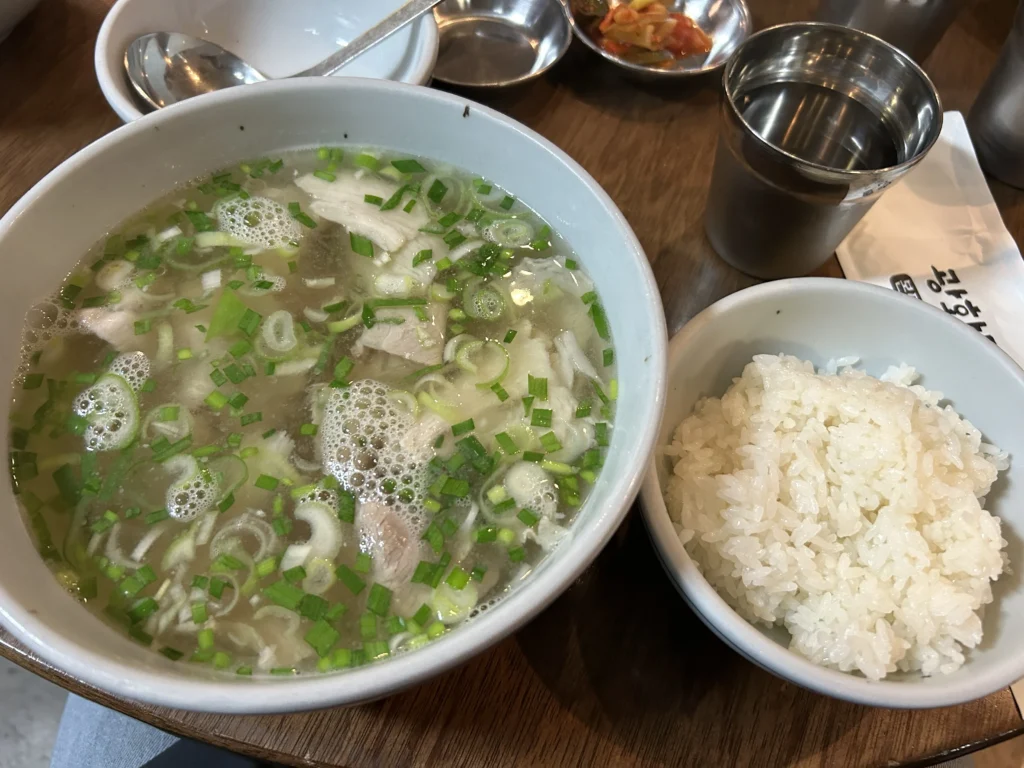
Gukbap — pork and rice soup, simple and deeply satisfying. In Seoul, the Gwanghwamun area has several famous spots. I went to Gwanghwamun Gukbap in 2024 — off-peak timing, pork spine broth with rice and kimchi. The entire meal cost ₩9,000 (~NZ$10.40 / ~US$6.10) (April 2026). One of Seoul’s best value bowls, and it now carries a Michelin recognition. I think about it regularly.
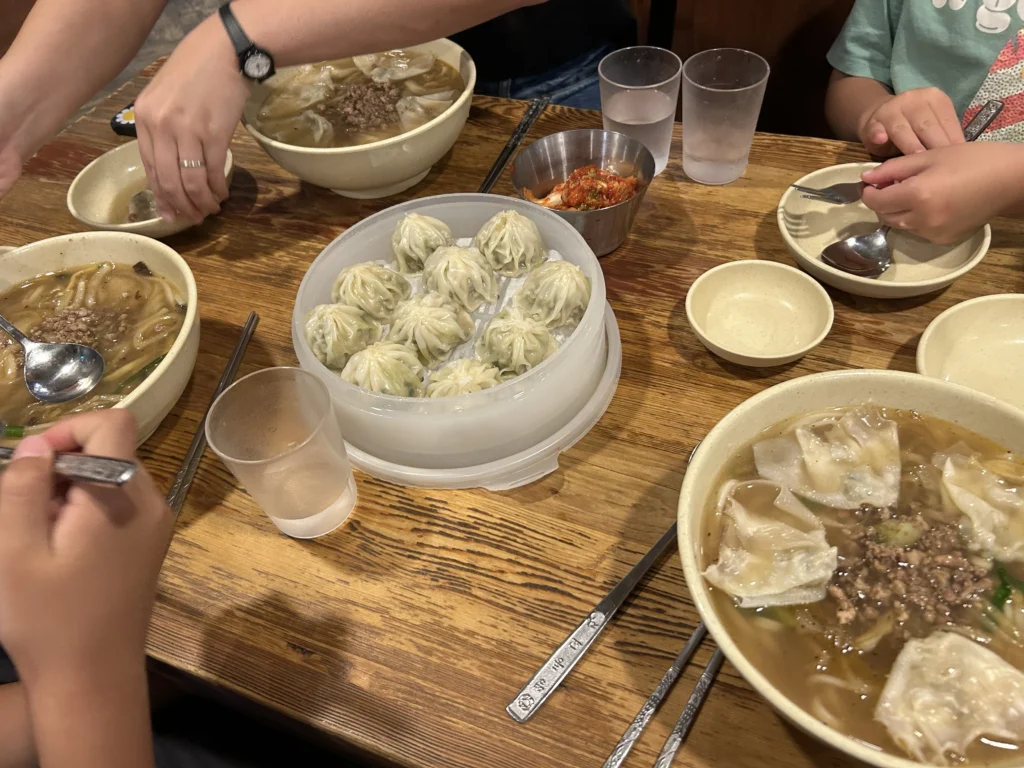
Myeongdong Gyoja — handmade dumplings (mandu) and kalguksu (knife-cut noodle soup) in Myeongdong. Famous enough to be a tourist site, but the food justifies the queue. Don’t skip it because it looks busy. The queue moves faster than it looks.
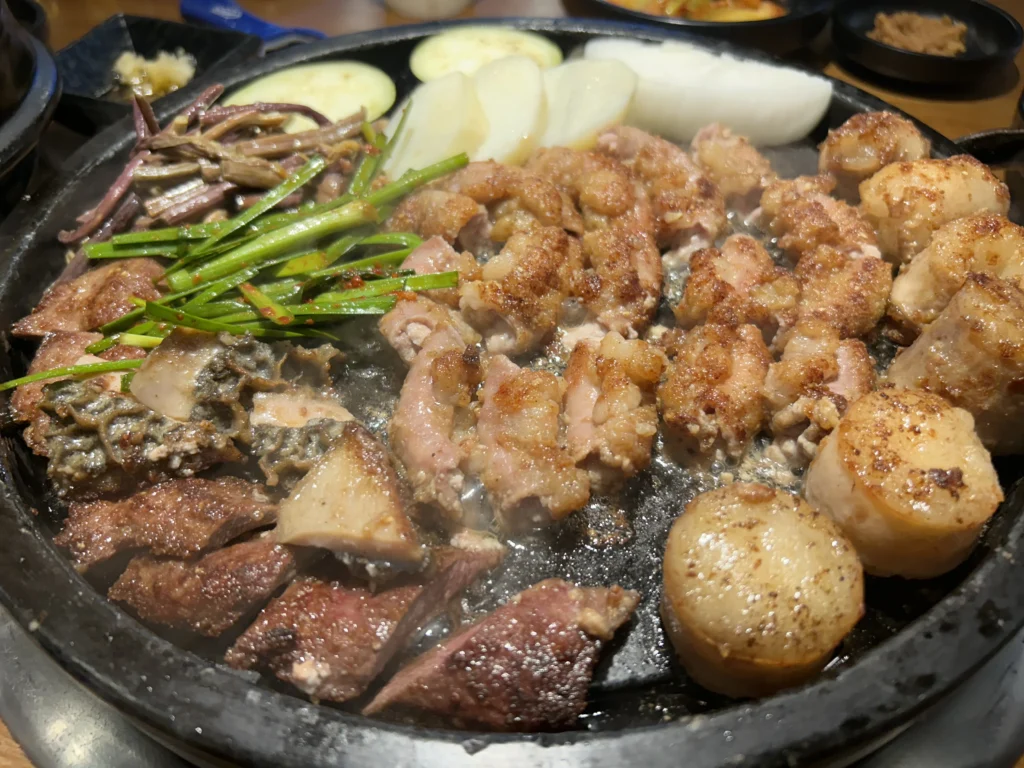
Gopchang — beef or pork intestines grilled over charcoal. This sorts people into two camps immediately. I’m firmly in the pro camp. Charred outside, fatty and rich inside, eaten with soju and scissors. Not for everyone. Genuinely excellent for the people it’s for.
Korean BBQ and Hot Pot: Ssam, Galbi, Shabu-shabu
Three dishes I’ve eaten on multiple Korea trips that never disappoint:
Pork galbi — marinated pork ribs grilled at the table, wrapped in lettuce with garlic and ssamjang. The foundational Korean BBQ experience. If you haven’t done this, start here.
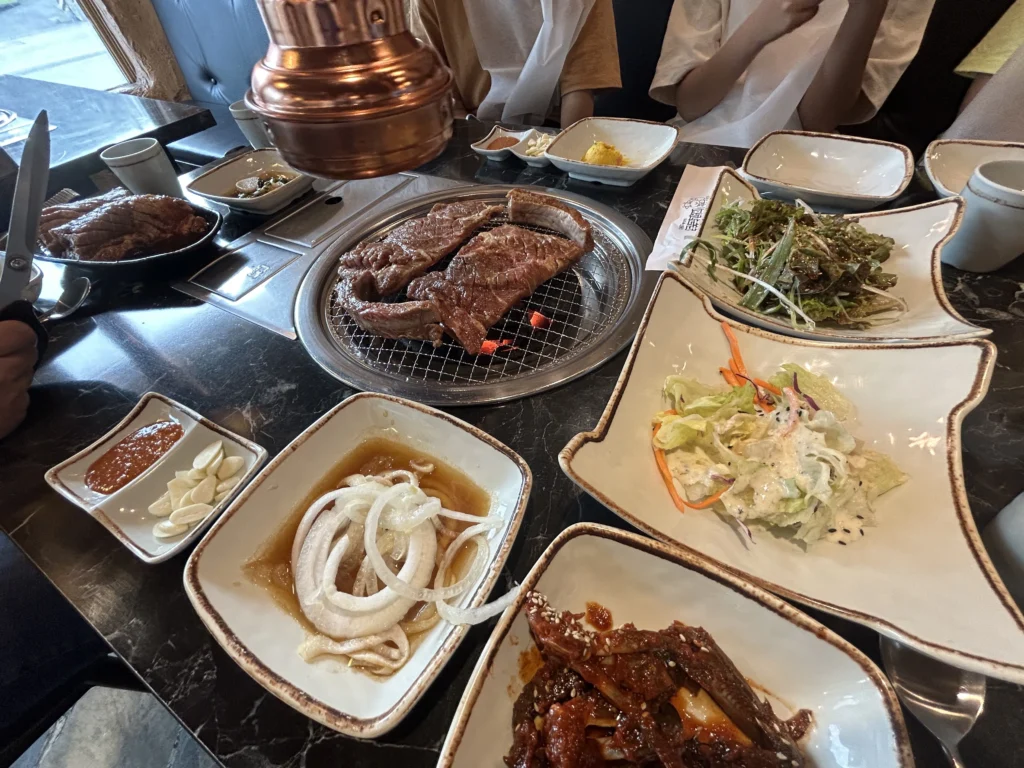
Ssambap — the same wrapping concept applied to a full meal: rice, various meats and vegetables, wrapped in lettuce or perilla at your own pace. More leisurely than standard BBQ.
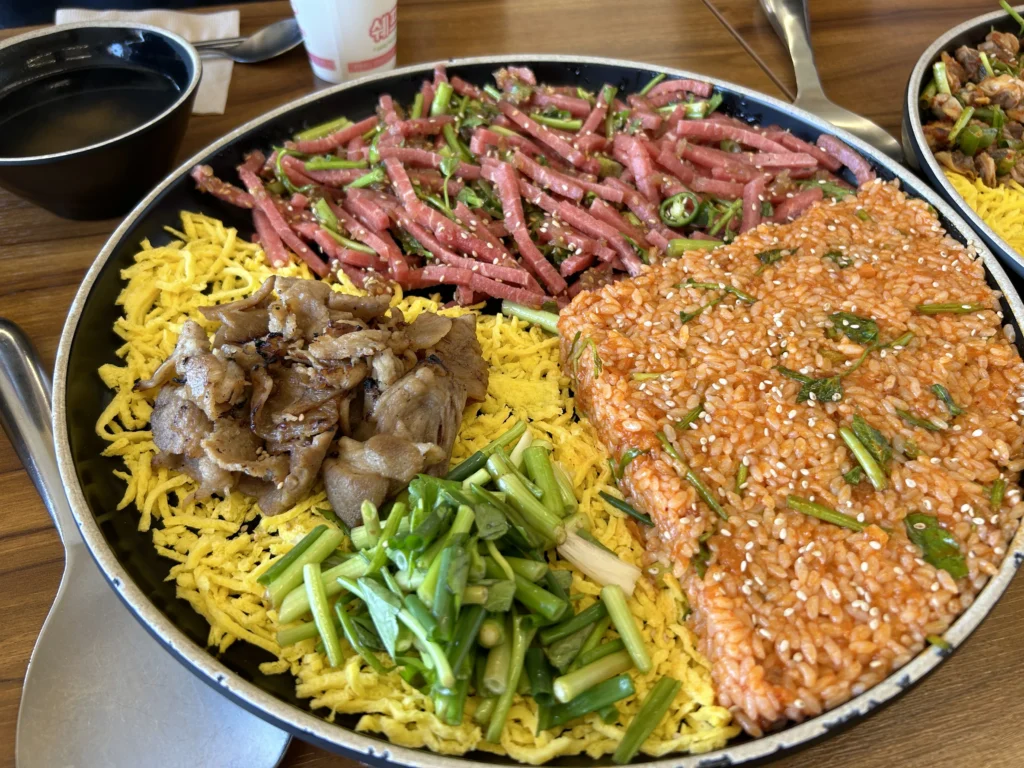
Shabu-shabu — thin-sliced beef or pork swirled in hot broth at the table, served with a wide spread of vegetables and dipping sauces. Light enough that you feel virtuous while eating it, substantial enough that you don’t finish hungry. Reliable and underrated.
Korean Family Buffet Restaurants: Ashley, Pizza Club & Coo Coo
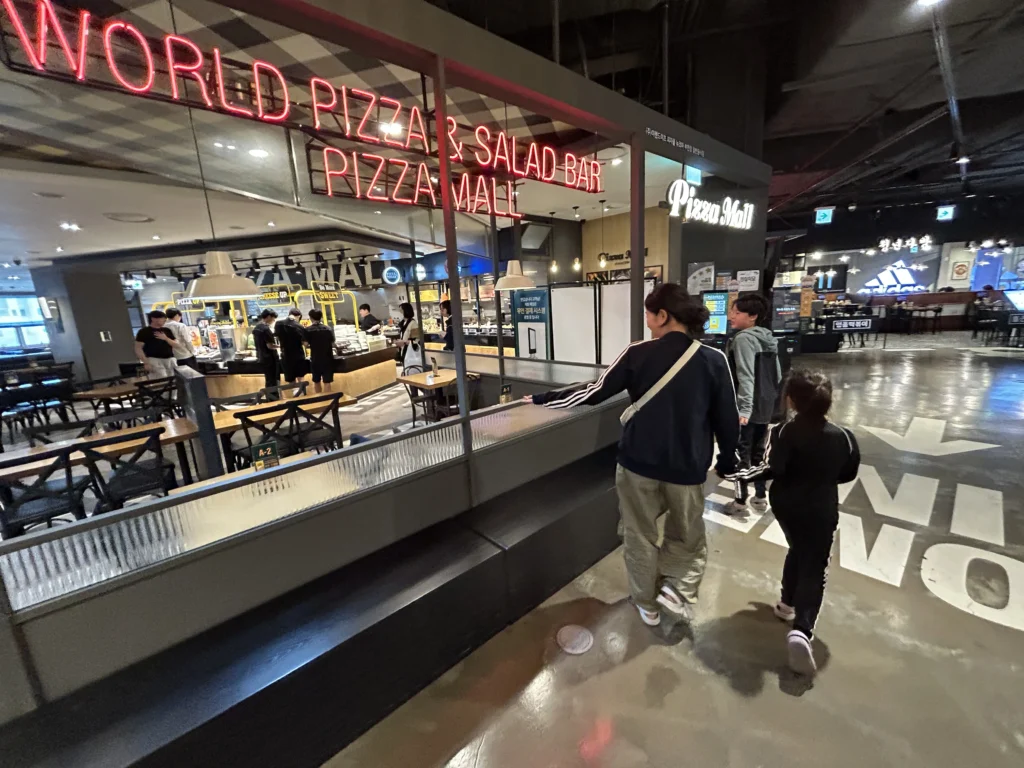
New Zealand doesn’t really have a restaurant category equivalent to the Korean family buffet. Not in terms of price, variety, or sheer volume of what you get. This is the category where our whole family — different ages, different preferences — consistently ended up happy.
Ashley’s is the one we return to most. It’s a Korean casual buffet chain mixing Korean and Western dishes: galbi, stir-fried items, salads, pasta, desserts, soft-serve — all at the same table, all unlimited. It sounds like it shouldn’t work. It works. The quality is better than “buffet food” implies, the atmosphere is relaxed, and for a family of four with kids at different ages and appetite levels, it solves the problem of everyone wanting something different. Around ₩15,000–23,000 per person (~NZ$17–27 / ~US$10–16) depending on location and time (April 2026).
Pizza Club is the simpler version — all-you-can-eat pizza, pasta, and sides at a lower price point. It’s not gourmet pizza. The kids don’t care. It’s the Korean equivalent of a mid-week family dinner that costs less than one adult main in a NZ restaurant. Around ₩9,000–13,000 per person (~NZ$10–15 / ~US$6–9).
QooQoo is the one Korean teenagers specifically request. Japanese-style conveyor belt sushi — all-you-can-eat, rotating plates on a belt, additional orders via touchscreen. Standard nigiri and rolls plus Korean additions like spicy tuna. It’s not trying to be fine dining. It’s the kind of meal where you eat significantly more than planned and don’t regret it.
The price comparison to New Zealand is the whole point: ₩16,000–22,000 all-you-can-eat per person (~NZ$18.50–25.50 / ~US$11–15). In New Zealand, a plate of two-piece nigiri costs more than a full Coo Coo session. Teens who have lived in NZ understand this gap immediately, which is why it’s the first restaurant many of them suggest.
Practical notes (April 2026):
- Ashley’s and Pizza Club have branches in most shopping malls — easy to fit into any day
- Coo Coo: lunch is cheaper than dinner (₩16,000–18,000 vs ₩20,000–22,000); weekends fill up, arrive early
Jjimjilbang Food: A Korean Food Experience That Exists Nowhere Else
Korean bathhouses (jjimjilbang) have a food culture attached to them that genuinely exists nowhere else on earth — and it belongs on any Korean food bucket list.
The standard order: makbanseok gyeran — eggs slow-cooked on the heated granite floor until the whites turn brown and the interior becomes almost caramel. Eaten in the communal rest area in paper-thin towels with iced barley tea. Also: pporo pporo cream tteokbokki — a chain operating inside jjimjilbang, serving a creamy, mild tteokbokki that’s become its own cult item.
I can’t fully explain why these foods taste better in this specific context. They just do.
The Honest Ending: What Happens When You Go Home
Both times I came back to Christchurch from Korea, the same thing happened: I lost my appetite for a week.
Not because the food here is bad — it isn’t. But after a month of eating three proper meals a day, surrounded by options at every street corner, coming back to a country where restaurants close at 9pm and a takeaway costs $20 requires a genuine recalibration.
The 2022 trip: 4kg gained. Took three months to lose it. No regrets.
The 2024 trip: 2–3kg. I’m calling that a win.
If you’re planning a Korea trip as an overseas Korean or a first-time visitor, budget for eating more than you expect to. Not because you’ll be wasteful — because the food density and the price point will simply make it the natural thing to do. That’s not a warning. That’s a recommendation.
Korean Food Cost Guide (April 2026)
| Category | Per meal / item | NZD approx | USD approx |
|---|---|---|---|
| Iced americano (franchise café) | ₩1,500–1,800 | ~NZ$1.75–2.10 | ~US$1.00–1.20 |
| Convenience store dosirak meal | ₩5,000–6,000 | ~NZ$5.80–7.00 | ~US$3.40–4.10 |
| Street tteokbokki + sundae + fried | ₩8,000–10,000 | ~NZ$9.30–11.60 | ~US$5.40–6.80 |
| Sulbing shaved ice | ₩11,900–17,000 | ~NZ$13.80–19.70 | ~US$8.10–11.50 |
| Gukbap / noodle bowl | ₩9,000–16,000 | ~NZ$10.40–18.60 | ~US$6.10–10.90 |
| Korean fried chicken (franchise) | ₩23,000–30,000 | ~NZ$26.70–34.80 | ~US$15.60–20.30 |
| Korean fried chicken (supermarket) | ₩7,000–12,000 | ~NZ$8.10–14.00 | ~US$4.80–8.10 |
| Pork galbi BBQ (per person) | ₩15,000–25,000 | ~NZ$17.40–29.00 | ~US$10.20–17.00 |
| Fresh sashimi (per person) | ₩20,000–35,000 | ~NZ$23.20–40.60 | ~US$13.60–23.80 |
Exchange rate: ₩1,000 ≈ NZ$1.16 / US$0.68 (April 2026)
FAQ
Is Korean food expensive for tourists?
No, Korean food is not expensive for tourists — it’s one of the most affordable food destinations in Asia. Budget ₩30,000–50,000 per day (~NZ$34–56 / ~US$22–36) for three solid meals including drinks, and you’ll eat very well. Even splurge meals at well-known restaurants tend to be cheaper than equivalent dining in New Zealand or Australia.
What Korean food is best for first-time visitors?
The best Korean food for first-time visitors to start with is pork galbi (BBQ ribs), tteokbokki from a street stall, and anything from a convenience store. These are all approachable, widely available, and genuinely representative of how Koreans eat day-to-day. Myeongdong Gyoja dumplings are also a reliable first-timer choice — the queue is there for a reason.
What Korean food is kid-friendly?
The most kid-friendly Korean foods are bibimbap (rice with toppings), Korean fried chicken, mild-version tteokbokki (look for cream or soy-garlic versions), kimbap (seaweed rice rolls), and anything from a convenience store. Our kids ate mild tteokbokki, galbi, and convenience store snacks on every trip without complaint.
What Korean food can you bring back to New Zealand?
Packaged and dried foods travel well back to New Zealand: instant ramen, dried seaweed snacks, barley tea bags, and shelf-stable tteok. Fresh food requires a customs declaration. Check MPI New Zealand biosecurity rules before packing — the rules are strict and fines for non-declaration are real.
How much weight will I gain eating through a Korean food bucket list for a month?
More than you’d like. I gained 4kg in 2022 and 2–3kg in 2024. The combination of food density, low prices, and the cultural pressure to eat three full meals a day makes restraint genuinely difficult. Budget for it, embrace it, and deal with it when you’re home.
Related Guides
- Korea with Kids: 8 Unique Experiences They Can’t Have in New Zealand — the activities companion to this post
- Singapore Changi Layover Guide with Kids — if you’re routing through Singapore on the way
- New Zealand Family Travel Budget Guide