
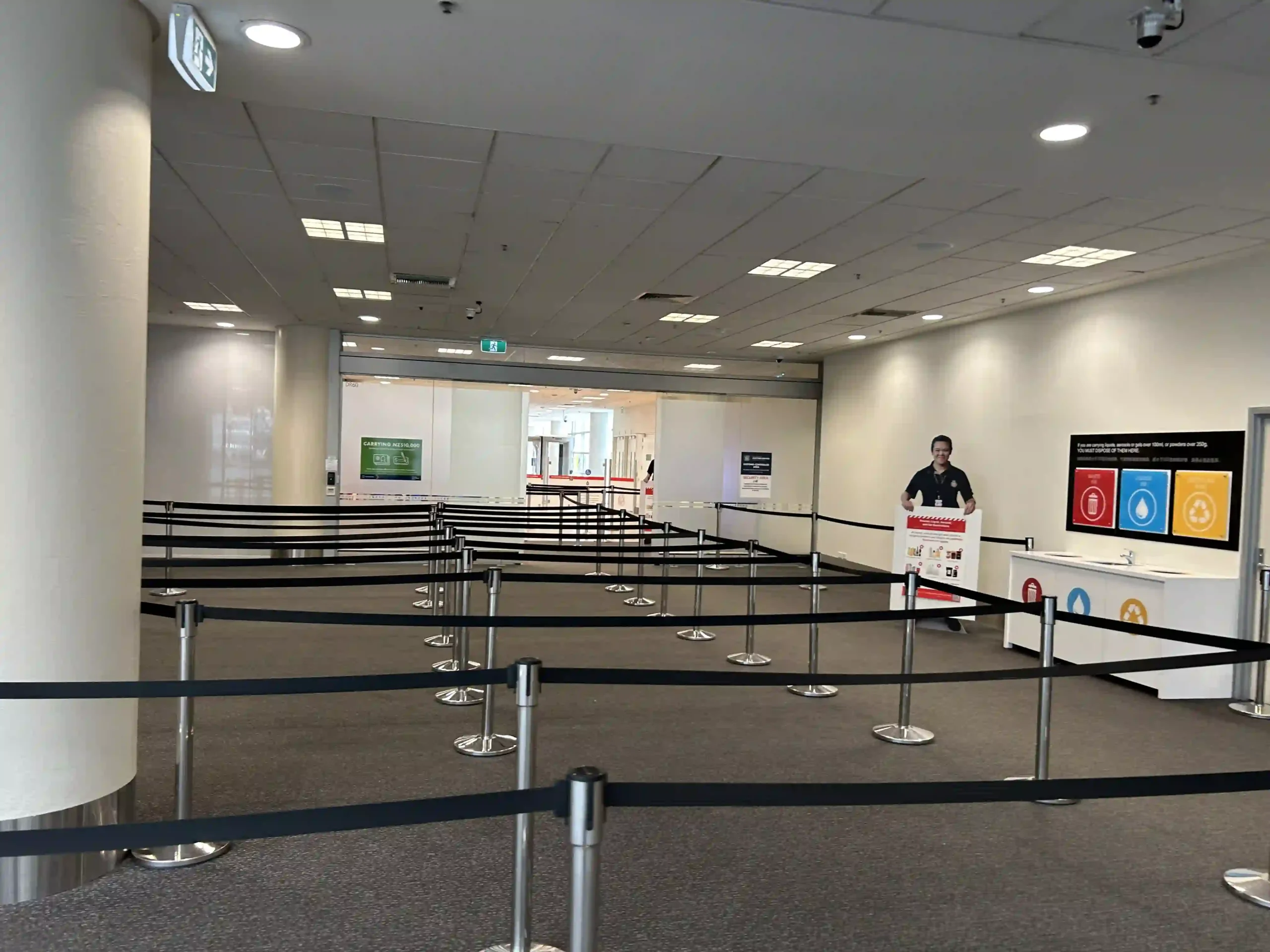
New Zealand aviation security (AvSec) confiscated 282,816 batteries from passengers in 2025. That number is not a typo. More than a quarter of a million batteries — removed from bags, left at the checkpoint, lost.
Most of those passengers didn’t know the rule. It’s one of the most consistently misunderstood items in air travel, and it’s also one of the easiest to get right once you understand it.
Having flown in and out of New Zealand airports for 11 years — Christchurch, Auckland, Wellington — I’ve watched the battery checkpoint drama unfold more times than I can count. The person ahead in the queue, confused, holding up a power bank while a security officer explains what can’t go in the bag being checked. Every time, the same look: genuine surprise.
This guide covers everything: what goes where, the watt-hour limits, what specifically gets taken, and the 2026 rule change that’s catching tool users off guard.
The Quick Answer
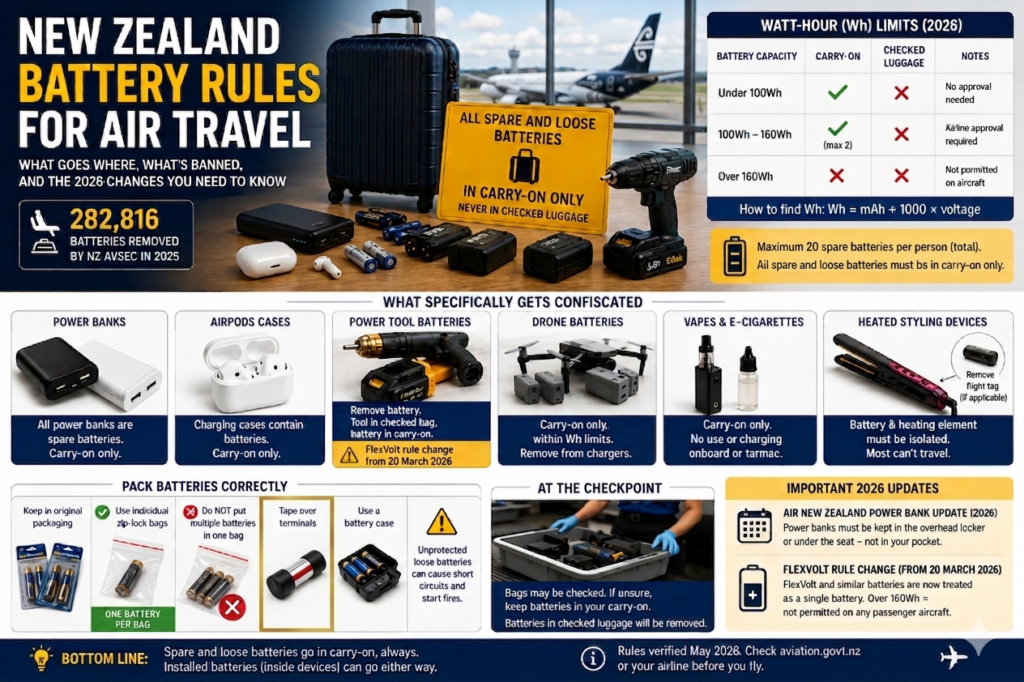
All spare and loose batteries must go in your carry-on bag. They are completely prohibited from checked-in luggage — no exceptions.
This applies to:
- Power banks
- AirPods charging cases and other wireless earbud cases
- Loose AA, AAA, and lithium batteries
- Power tool batteries
- Drone batteries
- Any battery that is not installed inside a device
If the battery is inside a device (phone, laptop, camera), it can go in either bag. If it’s loose or a spare, it must be in your carry-on.
Why Batteries Can’t Go in the Hold
Lithium batteries can catch fire — and when they do, they’re extremely difficult to extinguish. In the cabin, crew can see a battery fire and respond immediately. In the hold, a fire can go undetected until it’s out of control.
This isn’t theoretical. There have been aircraft incidents globally attributed to lithium battery fires in checked luggage. The rule exists because the risk profile is genuinely different depending on where the battery sits on the plane.
AvSec’s position is clear: loose batteries in the hold create a risk that isn’t acceptable. Hence the 282,816 removals.
The Watt-Hour (Wh) Limits: What You Need to Know
Not all batteries are equal. The capacity matters. Here’s the official breakdown from the Civil Aviation Authority of New Zealand (2026):
| Battery capacity | Carry-on | Checked luggage | Notes |
|---|---|---|---|
| Under 100Wh | ✅ Allowed | ❌ Banned (if spare) | No approval needed |
| 100Wh – 160Wh | ✅ Allowed (max 2) | ❌ Banned | Airline approval required |
| Over 160Wh | ❌ Not permitted | ❌ Not permitted | Banned from aircraft entirely |
How to find your battery’s Wh rating:
Check the label on the battery itself. If it shows mAh instead of Wh, use this formula:Wh = mAh ÷ 1000 × voltage
A standard 20,000mAh power bank at 3.7V = 74Wh. Well within limits.
A 26,800mAh power bank at 3.7V = 99.16Wh. Still fine, but close to the 100Wh threshold.
Most consumer power banks fall under 100Wh. The limit becomes relevant for high-capacity laptop batteries and professional camera batteries.
Maximum number of spare batteries: 20 per person, total.
What Specifically Gets Confiscated
Power Banks
The single biggest category of confiscated items. Power banks are spare batteries by definition — they exist to charge other devices, and they contain lithium cells.
Rule: All power banks must be in carry-on. Every single one. A power bank in your checked suitcase will be removed at the checkpoint before the bag goes into the hold, or identified during bag screening and pulled out.
If you’re checking in a bag and you’ve packed your power bank in it, go back and move it before you reach the counter. Checking in a bag with a power bank inside typically means it gets pulled out and handed back to you, which adds time and stress to a process that’s already got enough of both.
AirPods Cases and Wireless Earbud Charging Cases
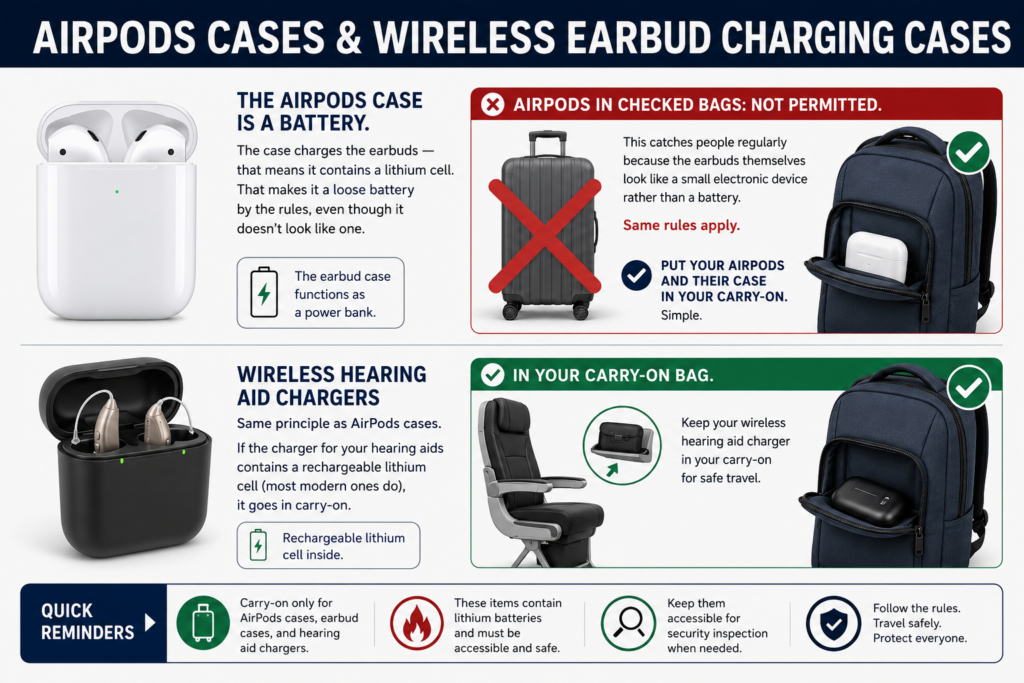
The AirPods case is a battery. The case charges the earbuds — that means it contains a lithium cell. That makes it a loose battery by the rules, even though it doesn’t look like one.
AirPods in checked bags: not permitted.
This catches people regularly because the earbuds themselves look like a small electronic device rather than a battery. The earbud case functions as a power bank. Same rules apply.
Put your AirPods and their case in your carry-on. Simple.
Wireless Hearing Aid Chargers
Same principle as AirPods cases. If the charger for your hearing aids contains a rechargeable lithium cell (most modern ones do), it goes in carry-on.
Power Tool Batteries
This is where it gets more interesting — and where the 2026 rule change matters most.
Standard cordless tool batteries (like an 18V Makita or Milwaukee battery) typically fall between 36Wh and 80Wh. These are permitted in carry-on only, never checked luggage.
If the battery detaches from the tool, always remove it. The tool itself — the drill, the saw, the sander — can go in checked luggage once the battery is out. The battery must travel separately in your carry-on, terminals protected. This applies to all power tools with removable batteries: remove the battery before you pack, and never assume the tool and battery can travel together in the hold just because the battery is attached.
The 2026 FlexVolt change:
DeWalt FlexVolt batteries and similar “flex-volt” style batteries were previously treated as multiple separate batteries within a single unit. AvSec allowed them because, individually, each cell was under the 160Wh limit.
From 20 March 2026, this classification changed. FlexVolt batteries are now treated as a single battery. If the total combined Wh exceeds 160Wh, the battery cannot travel on a passenger aircraft at all.
Check your FlexVolt battery’s label. If the combined rating exceeds 160Wh, it cannot come with you on any New Zealand flight.
Drone Batteries
Drone batteries vary widely — small recreational drone batteries are usually well under 100Wh, while professional-grade drone batteries can exceed 160Wh.
Rules are the same: must be in carry-on, must be within the Wh limits. A DJI Mini 4 Pro battery (2453mAh / 7.38V = approximately 18Wh) is fine. A professional filming drone battery can easily exceed 160Wh and cannot fly at all.
Drone charging cases: batteries must be removed. Many drone users now travel with multi-battery charging hubs or charging cases — a single case that holds and charges four or more batteries at once. These are convenient on the ground but create a problem at the airport. Batteries cannot travel inside a charger or charging hub. Each battery must be removed from the case, individually protected (terminals covered), and packed separately in your carry-on. The charging case itself, once empty, can go in either bag. If AvSec sees a charging hub full of batteries on the X-ray, the entire thing will be flagged and likely removed.
If you’re travelling with drone gear, check the specific Wh rating of each battery before you pack, and remove every battery from every charger before you reach the airport.
Vapes and E-Cigarettes
Vapes, e-cigarettes, and all vaping devices contain lithium batteries. Same rule applies: carry-on only, never checked luggage.
This catches people who assume vaping gear travels like any other personal item. It doesn’t. The battery inside a vape is treated the same as any other lithium cell — it cannot go in the hold because it’s a fire risk that crew cannot access or respond to mid-flight.
The rules:
- Vaping devices and all components: carry-on only
- Cannot be used on the aircraft or while crossing the tarmac
- Cannot be charged on board
- Vaping liquid: subject to the 100ml liquid rule in carry-on
Air New Zealand’s position has been evolving — some guidance states e-cigarettes are not permitted for carriage at all on certain routes, while others specify carry-on only. Check directly with your airline before travel. The baseline rule: if you’re flying with a vape, it goes in your carry-on and stays off for the entire journey including boarding.
Battery-Powered Heated Hair Styling Devices
This is the most misunderstood category in the entire battery rules system, and it specifically catches people travelling with wireless hair straighteners, curling irons, hair combs, and beard straighteners.
The rule (direct from AvSec):
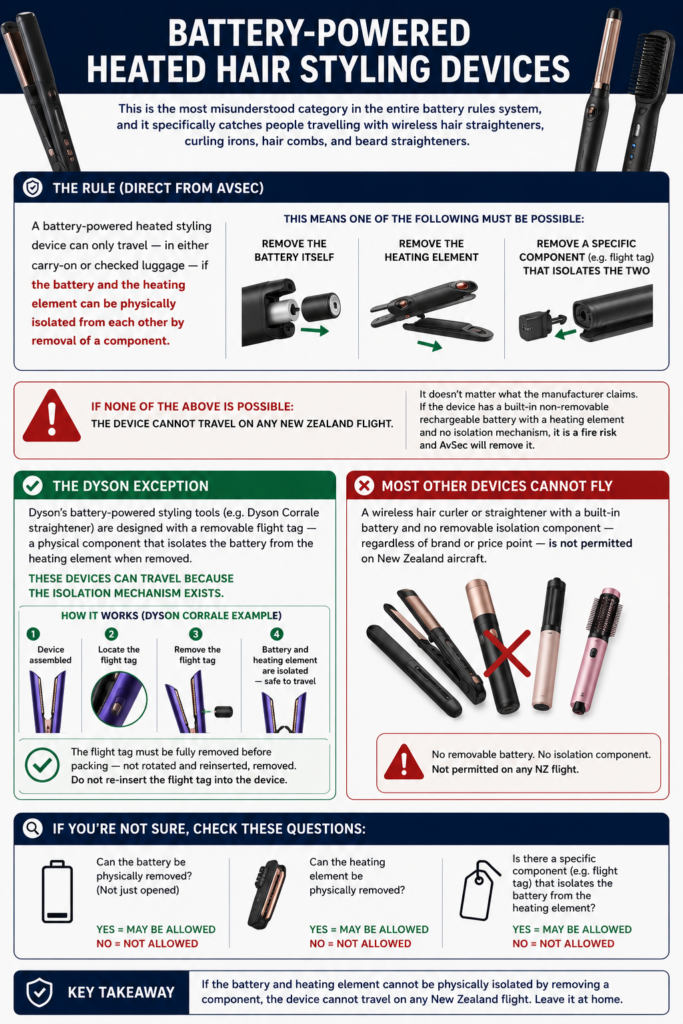
A battery-powered heated styling device can only travel — in either carry-on or checked luggage — if the battery and the heating element can be physically isolated from each other by removal of a component.
This means one of the following must be possible:
- Remove the battery itself, OR
- Remove the heating element, OR
- Remove a specific component (such as a flight tag) that isolates the two
If none of the above is possible: the device cannot travel on any New Zealand flight.
It doesn’t matter what the manufacturer claims. If the device has a built-in non-removable rechargeable battery with a heating element and no isolation mechanism, it is a fire risk and AvSec will remove it.
The Dyson exception:
Dyson’s battery-powered styling tools (the Dyson Corrale straightener, for example) are designed with a removable flight tag — a physical component that isolates the battery from the heating element when removed. These devices can travel because the isolation mechanism exists.
The flight tag must be fully removed before packing — not rotated and reinserted, removed. AvSec’s instructions are specific on this point: do not re-insert the flight tag into the device.
Most other wireless heated styling tools cannot fly. A wireless hair curler or straightener with a built-in battery and no removable isolation component — regardless of brand or price point — is not permitted on New Zealand aircraft.
If you’re not sure whether your device qualifies, check whether the battery or a named flight component can be physically removed. If it can’t, leave the device at home.
How to Pack Batteries Correctly
The rule isn’t just where — it’s also how.
Terminals must be covered or protected. This means:
- Leave batteries in their original packaging if you have it
- Use individual small zip-lock bags for loose batteries
- Put tape over the terminals of batteries removed from packaging
- Use a dedicated battery case (widely available, inexpensive)
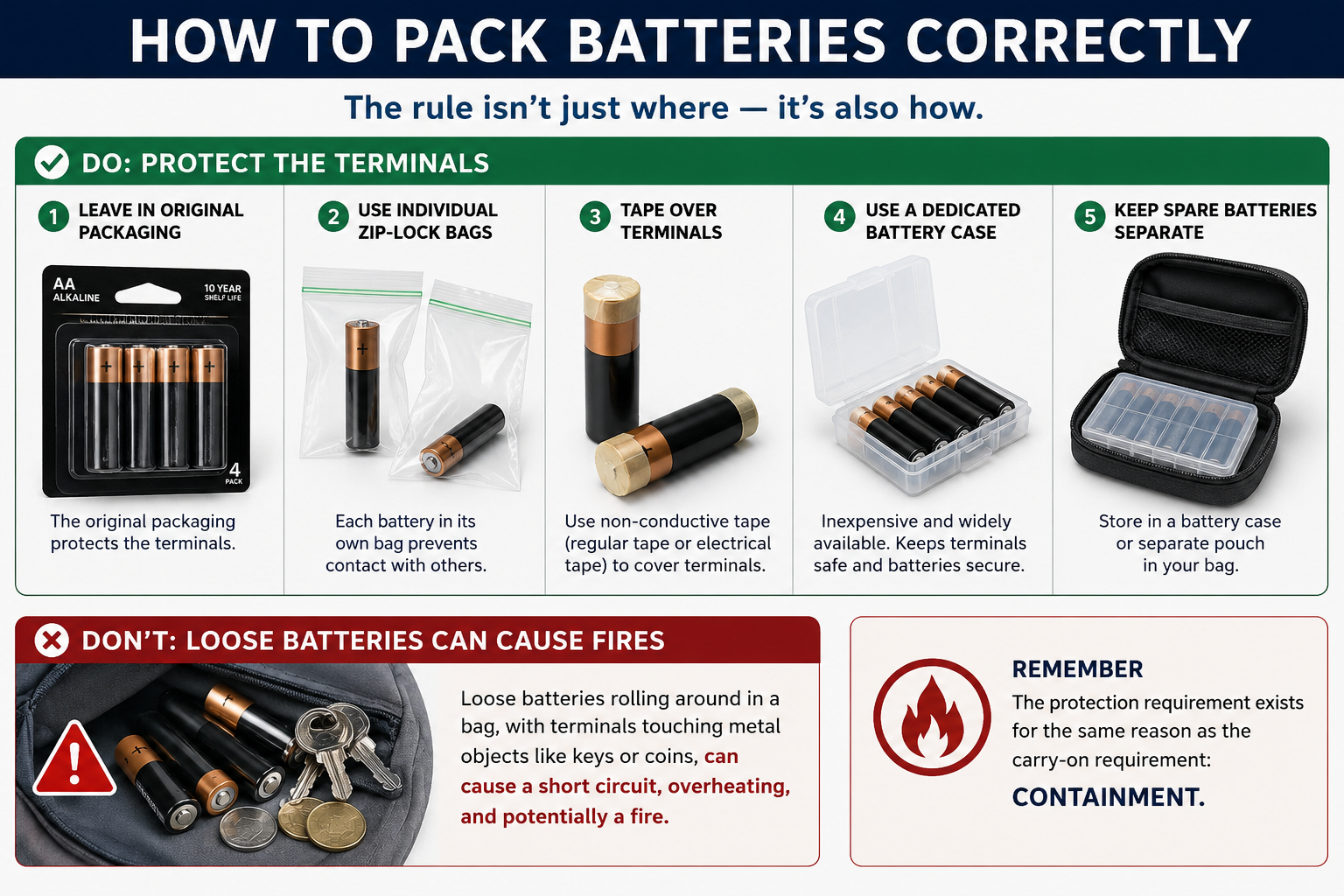
Loose batteries rolling around in a carry-on bag, terminals touching metal objects like keys or coins, is a genuine fire risk. The protection requirement exists for the same reason as the carry-on requirement: containment.
Practical packing approach for a family trip:
- Power banks: front pocket of carry-on bag, never checked suitcase
- AirPods: in carry-on, inside their case
- Camera batteries: in carry-on, terminals covered with tape or in individual pouches
- AA/AAA batteries: carry-on, in original packaging or zip-lock
- Laptop: either bag (it’s an installed battery), but battery stays in laptop
At the Checkpoint: What to Expect
If you have batteries in your carry-on, they’ll go through the X-ray with everything else. You don’t need to remove them separately (unlike laptops, which may need to come out).
If security flags something, they’ll scan again or open the bag. This is routine — carry-on bags with multiple power banks or camera equipment get second looks.
What triggers a bag pull: batteries in checked luggage, batteries without terminal protection that look concerning on X-ray, batteries exceeding Wh limits.
The golden rule: If you’re unsure, keep it in carry-on. The downside of having a battery in your carry-on that could have gone in checked luggage is zero. The downside of putting a battery in your checked bag is getting it pulled out at security.
Air New Zealand’s 2026 Power Bank Update
Air New Zealand updated its power bank rules in early 2026 in response to a series of in-flight incidents globally involving overheating power banks.
Key update: power banks must be kept in the overhead locker or under the seat in front — not in your pocket during flight. If a power bank shows signs of overheating (hot to the touch, swelling, unusual smell), cabin crew are trained to respond and isolate it.
Check Air New Zealand’s current dangerous goods page before travel if you’re carrying high-capacity power banks, as airline-specific rules can be updated more frequently than CAA regulations.
FAQ
Can I put a power bank in my checked luggage on a New Zealand flight?
No. Power banks are spare lithium batteries and are completely prohibited from checked luggage on all New Zealand flights. They must go in your carry-on bag.
How many power banks can I bring on a NZ flight?
You can carry up to 20 spare batteries total per person. Each power bank counts as one battery. If the power bank is between 100Wh and 160Wh, you’re limited to two of those, and you need airline approval.
Are AirPods allowed in checked luggage in New Zealand?
The earbuds themselves can go in checked luggage, but the AirPods charging case contains a lithium battery and must go in your carry-on. If in doubt, keep the entire AirPods setup in your carry-on.
What is the battery Wh limit for New Zealand flights?
Under 100Wh: permitted in carry-on, no approval needed. 100Wh to 160Wh: permitted in carry-on with airline approval, maximum two batteries. Over 160Wh: not permitted on passenger aircraft.
What happens if I accidentally put a battery in my checked bag?
AvSec will identify it during bag screening and remove it. You may be able to retrieve it before your flight, or it may be held for collection after travel. You won’t be fined for an honest mistake, but you may miss your flight if it causes a delay at screening.
Do AA or AAA batteries need to be in carry-on?
Standard alkaline AA/AAA batteries in quantities for personal use can go in either carry-on or checked luggage, but loose lithium AA/AAA batteries (the non-rechargeable lithium type used in cameras) should go in carry-on. When in doubt, carry-on.
Can I bring a vape or e-cigarette on a New Zealand flight?
Yes, but in carry-on only — never checked luggage. Vaping devices contain lithium batteries and are subject to the same carry-on-only rule as power banks. You cannot use or charge the device on board or while on the tarmac. Check with your specific airline before travel, as some routes have additional restrictions.
Can I bring my wireless hair straightener or curling iron on a NZ flight?
Only if the battery and heating element can be physically isolated — meaning you can remove the battery, the heating element, or a specific flight tag component. If your device has a built-in non-removable battery with no isolation mechanism, it cannot travel on any New Zealand flight regardless of what the manufacturer says. Dyson’s battery-powered styling tools with removable flight tags are among the few that qualify. If in doubt, check with AvSec before you pack it.
What’s the 2026 FlexVolt battery rule change?
From 20 March 2026, DeWalt FlexVolt and similar multi-cell batteries are treated as a single battery. If the combined watt-hour rating exceeds 160Wh, they cannot travel on any passenger aircraft in New Zealand.
Related Guides
More on smart travel prep in New Zealand:
- NZ Airport Security: What Gets Confiscated (Honey, Liquids & More)
- New Zealand Packing List — What to Actually Bring
- NZ Rental Car Insurance — Why Full Cover Is Worth It
Bottom Line
The rule is straightforward once you know it: spare batteries go in carry-on, always. Installed batteries (inside your phone, laptop, camera) can go either way. Everything else — power banks, AirPods cases, loose batteries, tool batteries — belongs in the bag you’re keeping with you.
AvSec removed 282,816 batteries in 2025. Most of those passengers knew the rule after the fact. Know it before.
Battery rules verified May 2026 against Civil Aviation Authority of New Zealand and Air New Zealand official guidance. Rules are subject to change — verify with your airline before travel at aviation.govt.nz.