
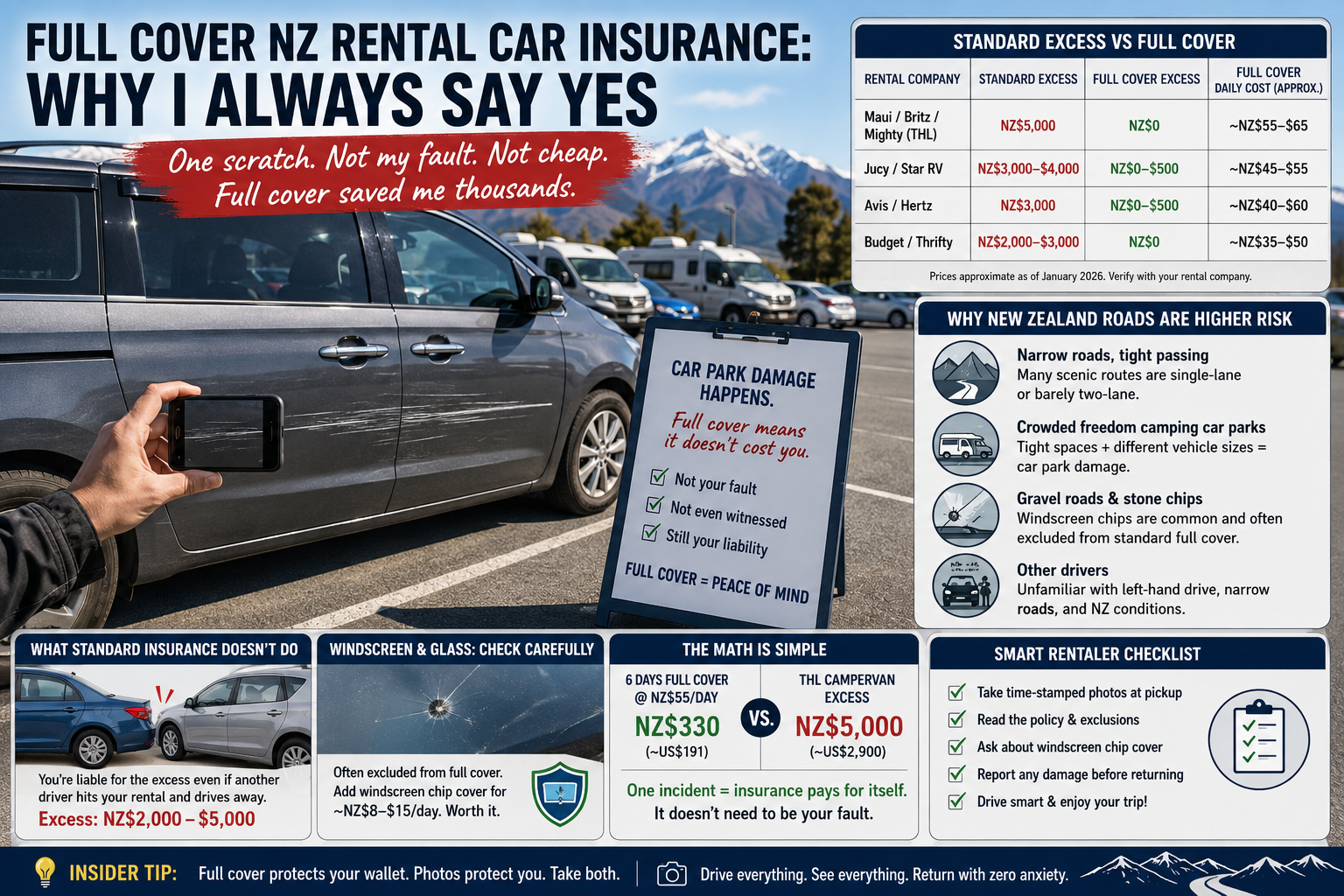
NZ rental car insurance feels like the oldest upsell in the book. You’ve already paid for the car. The desk agent slides the insurance sheet across and quotes you NZ$45–$65 a day for full cover. Your instinct says no.
Here’s why I now always say yes — and why a parking lot in New Zealand changed my mind permanently.
We’d just finished a 5-night, 6-day South Island trip. We drove down in a campervan, then switched to a Kia Carnival for the return leg. I dropped the family at home drove the Carnival back to the rental depot, and did the handover walk-around with the staff member.
Here’s the thing: I had full cover, so I hadn’t bothered taking photos when I picked the car up. I figured — what’s the point? I’m covered.
The rental staff pulled up the photos from when I’d collected the vehicle and compared them panel by panel. That’s when we found it. A scratch along the passenger door — someone had clipped it while it was parked and driven away without leaving a note. I hadn’t noticed it at all.
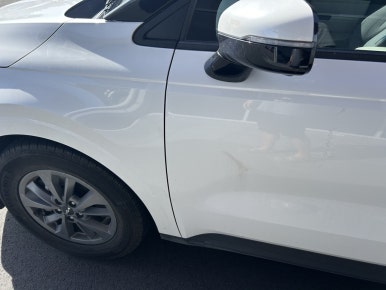
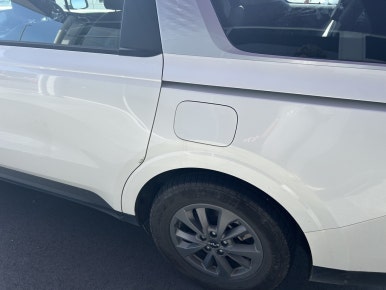
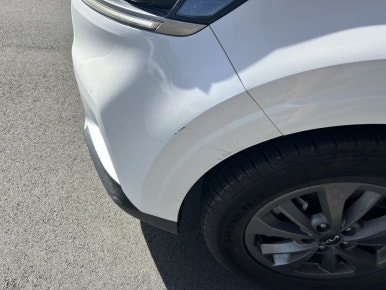
I hadn’t hit anything. Hadn’t scraped a post or misjudged a gap. The car sat in car parks while we ate, slept, and explored — and at some point, someone made contact and kept going.
I filed the accident report. And then I felt something I hadn’t expected: relief. Because I’d paid for full cover insurance. And that scratch was going to cost someone — just not me.
The Short Answer
The short answer: yes, buy full cover NZ rental car insurance. The excess (liability) on a standard rental agreement in New Zealand is typically NZ$2,000–$5,000. Full cover reduces that to zero or near zero. One car park incident — not your fault, not even witnessed — can trigger that full excess.
What “Standard” Rental Insurance Actually Covers (And Doesn’t)
Every New Zealand rental car comes with third-party liability insurance. That covers other people and their property if you cause an accident. It does not cover damage to the rental vehicle itself beyond a set threshold.
The part that surprises most people:
You are liable for the excess even if the other driver was at fault and drove away.
If someone scrapes your rental car in a car park and there’s no witness and no way to identify them, you have filed an accident report, and the rental company still processes a damage claim — that excess comes out of your credit card.
The standard excess varies by company:
| Rental Company | Standard Excess | Full Cover Excess | Full Cover Daily Cost |
|---|---|---|---|
| Maui / Britz / Mighty (THL) | NZ$5,000 | NZ$0 | ~NZ$55–$65/day |
| Jucy / Star RV | NZ$3,000–$4,000 | NZ$0–$500 | ~NZ$45–$55/day |
| Avis / Hertz | NZ$3,000 | NZ$0–$500 | ~NZ$40–$60/day |
| Budget / Thrifty | NZ$2,000–$3,000 | NZ$0 | ~NZ$35–$50/day |
Prices approximate as of January 2026. Verify directly with your rental company.
Why New Zealand Roads Are Higher Risk Than You Think
Having driven all over this country for 11 years, I want to be direct about something: New Zealand roads are not easy.
This isn’t about your driving ability. It’s about the environment:
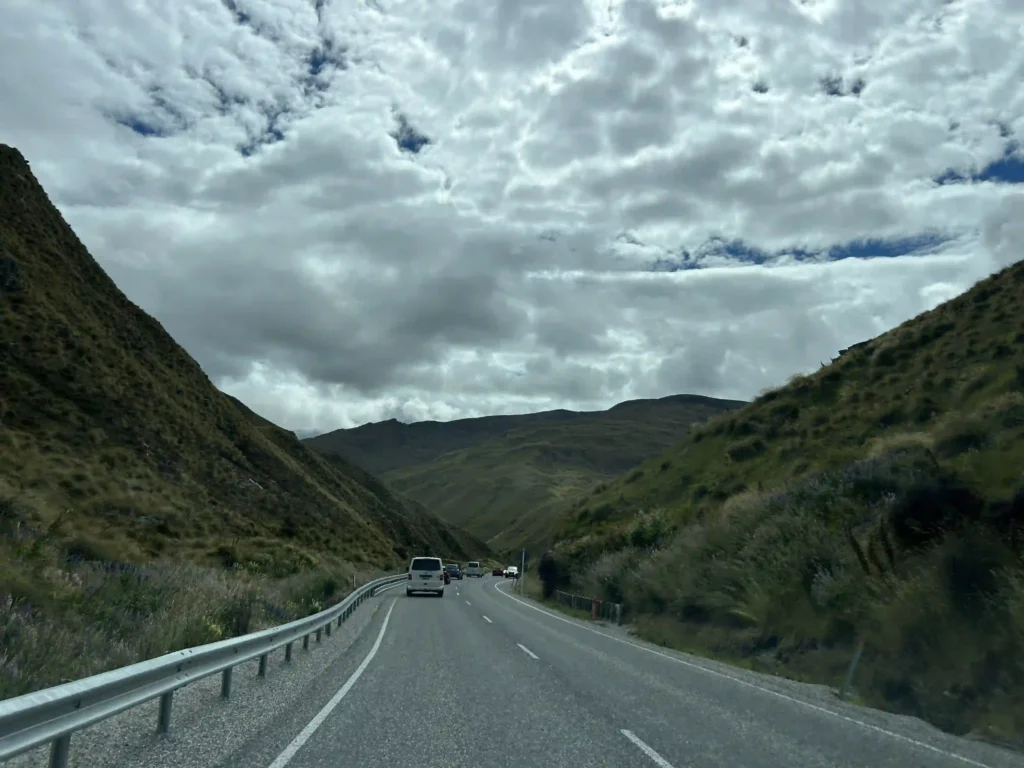
Narrow roads. Many South Island scenic routes — including the ones everyone wants to drive — are single-lane or barely-two-lane. Passing is tight. Verges don’t exist.
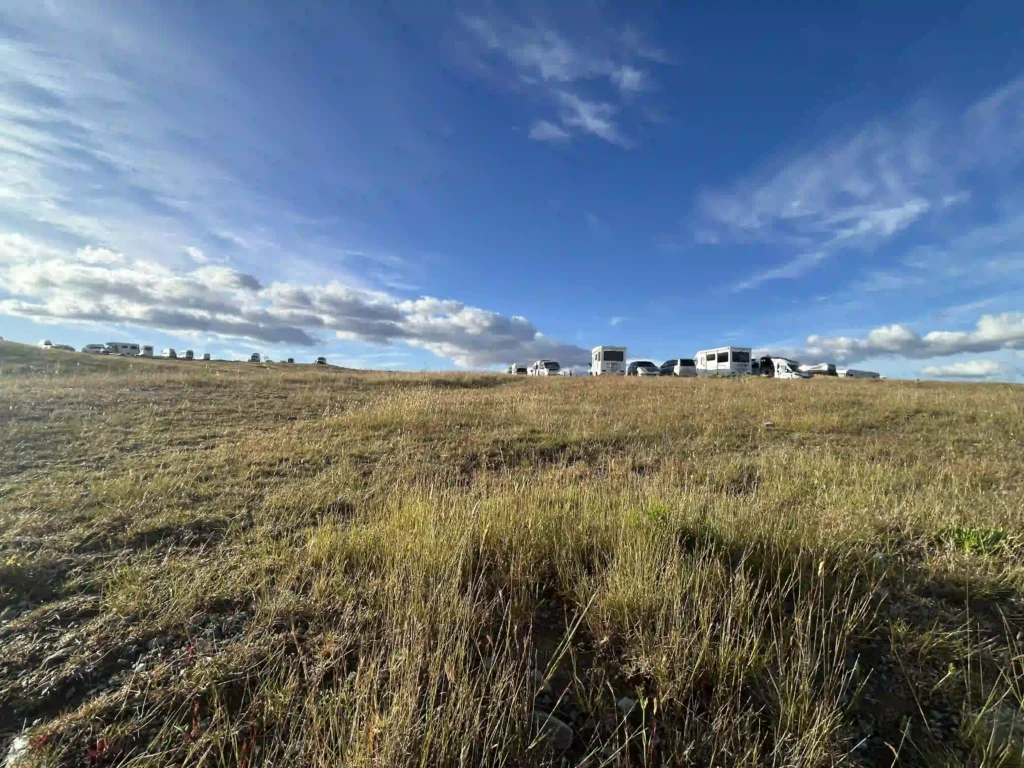
Freedom camping car parks. Popular overnight campervan spots fill up with vehicles of all sizes parked in tight formation. Manoeuvring in and out is when most car park damage happens.
Gravel roads and stone chips. The South Island in particular has a lot of unsealed or chip-seal roads, and vehicles travelling in either direction kick up loose stones constantly. Stone chips hitting your windscreen are not a rare event — they’re a near-certainty on a multi-day South Island drive. A chip that looks minor at pickup can spread into a full crack by the time you return the vehicle, especially in cold alpine conditions between Tekapo and Queenstown.
Here’s the part that catches people: windscreen chip damage is often excluded from standard full cover insurance. Many rental companies treat windscreen, glass, and tyre damage as a separate category. Full cover reduces your body damage excess to zero — but a stone chip to the windscreen may still trigger a separate windscreen excess of NZ$500–$1,500.
💡 If your full cover doesn’t explicitly include glass and windscreen damage, ask about a windscreen chip cover add-on. Most major rental companies offer this as a separate option for NZ$8–$15/day. For a South Island trip, it’s worth it. One chip repair on a rental windscreen runs NZ$200–$400; a full windscreen replacement can exceed NZ$1,000. Read the policy wording — look for “glass,” “windscreen,” and “chips” specifically.
Other drivers. Campervans and tourist vehicles driven by people unfamiliar with left-hand drive, narrow roads, and New Zealand passing rules. Incidents happen.
I drove 770km across the South Island on that trip without touching anything. Someone in a car park drove into the vehicle and left. That’s it. That’s how it happens.
The Credit Card Insurance Myth
“But my credit card covers rental car damage.”
This comes up constantly. Here’s the reality:
Most credit card rental car insurance is secondary coverage, not primary. It kicks in after your other insurance is exhausted, and often only in specific circumstances.
Common exclusions in credit card rental car policies:
- Campervans and motorhomes (many cards specifically exclude these)
- Vehicles over a certain weight or value
- New Zealand rentals under an NZ company (some cards only cover specific brands)
- Damage that isn’t collision (theft, overhead damage, tyre damage)
- Claims where you didn’t report to police within 24 hours
Before relying on credit card coverage, call your bank and ask specifically:
- Does this card cover campervans and motorhomes in New Zealand?
- Is this primary or secondary coverage?
- What is the claims process, and do I need to pay the excess upfront and claim back?
In my experience, the claims process alone — proving the rental, submitting damage reports, waiting for reimbursement — costs time and stress that the daily insurance fee simply doesn’t.
Campervans: Why Insurance Is Even More Critical
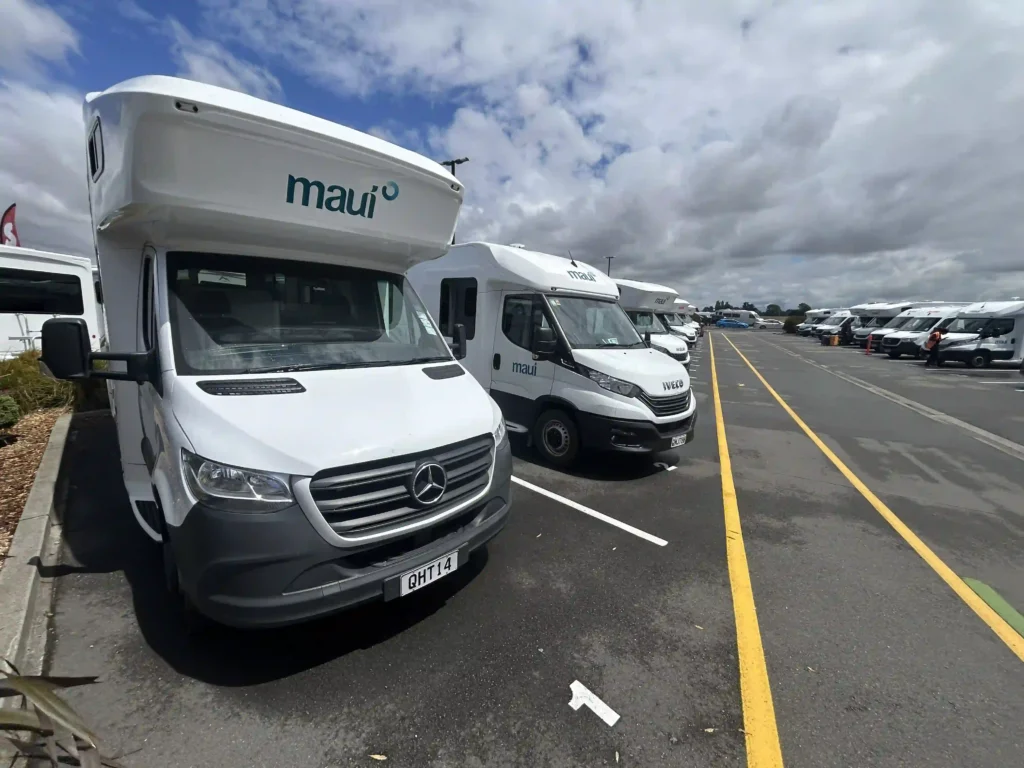
If you’re renting a standard car, the excess on a hit-and-run scratch is painful but survivable. If you’re renting a campervan — particularly a larger model — the stakes are higher:
Campervan panels are large and expensive to repair. A scratch on a 7-metre motorhome panel isn’t a door ding. It’s potentially a full panel respray.
Campervans are harder to park. Every parking manoeuvre is an opportunity for something to go wrong. Most incidents aren’t dramatic accidents — they’re slow-speed contact in tight spaces.
The “relocation deal” doesn’t change the insurance terms. If you’re using a campervan relocation deal (one of the best ways to get cheap South Island driving, which I’ve written about separately), the rental agreement and excess structure are the same as a standard hire. Don’t assume reduced cost = reduced liability.
💡 Insider Tip: Even with full cover, take time-stamped photos of every panel at pickup. I didn’t, because I thought “I’m covered, why bother?” — but at return, the rental staff compared their pickup photos against the car and found the damage that way. If the scratch had been pre-existing and I had no photos of my own, I’d have had no way to dispute it. Full cover protects your wallet; photos protect you from being charged for damage that was already there.
The Accident Report: What to Do If It Happens
If you find damage to your rental that wasn’t there when you picked up:
- Don’t panic. Take photos immediately — multiple angles, close-up and wide.
- Report it to the rental company before you return the vehicle. This is critical. Returning the vehicle without reporting discovered damage can be treated as your acknowledgement that it’s new damage.
- File an accident report. Even if you don’t know who caused it. Write down your best estimate of when and where the damage may have occurred.
- Contact your credit card company (if relying on that coverage) before you return the vehicle — some policies require notification within 24–48 hours.
The accident report I filed was brief. “Damage discovered at return. Passenger side lower panel. Likely occurred during overnight stop.” That was enough to trigger the insurance process — and because I had full cover, the financial outcome was zero.
Is Full Cover Worth It? The Maths
A 6-day South Island road trip at NZ$55/day for full cover = NZ$330 (~US$191).
The standard excess on a THL campervan = NZ$5,000 (~US$2,900).
One panel repair from a hit-and-run scratch = NZ$800–$3,000 (~US$464–$1,740) depending on the panel size and repair method.
You only need to avoid one incident to make the insurance pay for itself. And as I can tell you from personal experience: the incident doesn’t need to be your fault. It just needs to happen to your rental car.
What Full Cover Typically Includes (and What It Doesn’t)
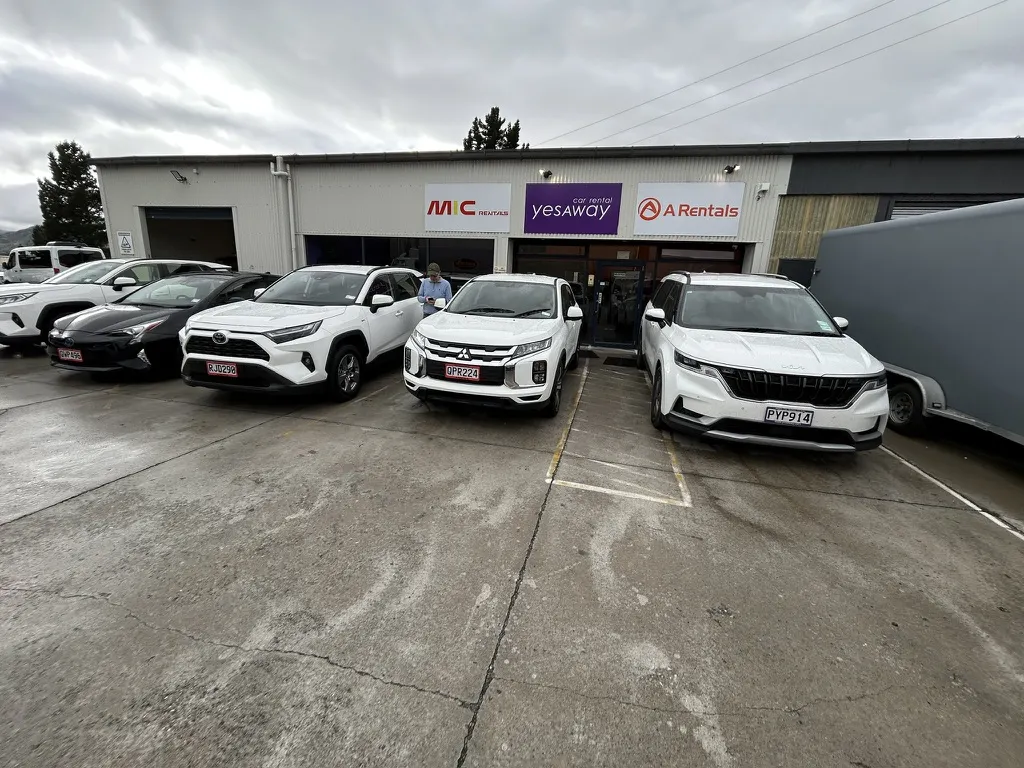
Usually included:
- Collision and single-vehicle accident damage
- Third-party damage
- Theft (vehicle and contents — check limits)
- Windscreen and tyre damage (often only with premium packages — verify before assuming)
Often excluded — check your policy:
- Windscreen chip and glass damage — frequently a separate category, not covered by standard full cover. Ask specifically, and consider adding windscreen chip cover (typically NZ$8–$15/day) if it’s not included. On a South Island trip this is not optional.
- Damage from overhead obstacles (tree branches, car park barriers) — this is its own separate category at many companies
- Damage while driving on unsealed/gravel roads (some companies restrict this)
- Damage caused by ignoring road closure signs
- Loss of personal belongings from the vehicle
Read the exclusions before you sign. The agent at the desk will tell you full cover means “everything is covered” — but what they mean is the standard covered events. The exclusions still exist.
FAQ
Is rental car insurance mandatory in New Zealand?
No. Third-party liability coverage is included automatically, but excess reduction insurance (full cover) is optional. You are legally allowed to decline it. However, you remain liable for the full excess amount on any claim.
Can I reduce my rental car excess without buying the company’s own insurance?
Yes. Third-party rental excess insurance products are available from providers like RentalCover.com and InsureandGo. These work by reimbursing your excess if a claim occurs. They’re often cheaper than buying directly from the rental company — but check that they explicitly cover the vehicle type and rental company you’re using.
Does travel insurance cover rental car damage in New Zealand?
Some comprehensive travel insurance policies include rental car excess coverage. Check whether this is included in your plan, the maximum excess covered, and whether it covers campervans. If your travel insurance includes rental car excess, you may be able to skip the rental company’s own product — but verify the claims process carefully.
What if I damage the rental car on a gravel road?
This depends entirely on the rental company’s policy. Many companies (particularly for campervans) restrict driving on unsealed roads or exclude damage that occurs on gravel. Read this section of your rental agreement carefully before venturing onto any gravel road.
How does New Zealand’s ACC (Accident Compensation Corporation) affect rental car claims?
ACC covers personal injury from accidents in New Zealand regardless of fault. It does not cover property damage to vehicles. Your rental car insurance is entirely separate from ACC.
Related Guides
Planning a South Island road trip? These posts cover the full picture:
- New Zealand Campervan Relocation Guide
- Relocation Car Rentals in New Zealand — How the Deals Work
- Smartest South Island Road Trip Route
Final Verdict
Full cover NZ rental car insurance is not a scam. It’s not an optional luxury. It’s the only thing standing between you and a multi-thousand-dollar claim for something that genuinely wasn’t your fault.
New Zealand car parks are full of vehicles operated by people who are tired, jet-lagged, and unfamiliar with driving on the left. Your rental car sits in those car parks for hours while you’re hiking, eating, or sleeping. You cannot watch it the whole time.
Pay the daily rate. Drive everything you want to drive. Return the car with zero anxiety.
Prices and excess amounts verified January 2026. Always confirm current pricing directly with your rental company before booking. For official information on rental vehicles in New Zealand, see the NZ Transport Agency (NZTA) rental vehicle guidance.