

The moment you land at Incheon, Seoul’s transit system will either be your best friend or your first headache. Here’s how to make sure it’s the former.
If you’ve ever stood at a ticket machine in a Seoul subway station while a hundred people rush past you — you know the feeling. The signs are everywhere, but nothing quite makes sense until someone shows you the one thing you actually need to do first.
The Seoul transit card system is genuinely one of the best in the world. But there are two different cards in play, and grabbing the wrong one (or missing your chance at the airport) will cost you time and money. I grew up in Korea and now live in New Zealand — which means every trip back to Seoul, I’m doing it all over again with fresh eyes. This guide is exactly what I wish someone had handed me at the arrivals gate.
The Short Answer: Which Seoul Transit Card Do You Need?
The short answer: Most visitors should pick up a T-money card at Incheon Airport immediately after clearing customs, then switch to a Climate Card once they’re in the city — if they’re staying 3+ days and plan to move around a lot.
Here’s the quick breakdown:
- T-money — buy it at the airport, works everywhere including the AREX airport train, pay per ride
- Climate Card — unlimited rides within Seoul for 1 to 7 days, but not on the airport train
- Apple Pay T-money (iPhone only) — no physical card, no account, set up in minutes via the Mobile T-money app; works on subways and buses but not with Climate Card or K-Pass
- Cash (KRW) is required to buy and top up physical cards
- A 10,000 KRW (≈ USD $7) starting top-up on T-money gets you into the city and through your first day
Why People Get This Wrong (And It’s Not Their Fault)
Seoul’s transit is efficient, but the card system wasn’t designed with foreign visitors in mind. Most people arrive at Incheon with no Korean won, skip the currency exchange because the rates look bad, and then stand in front of a ticket machine that only accepts cash or a local card.
The other trap: assuming your foreign credit card or contactless payment will work. It might — but don’t count on it. T-money and the Climate Card are the reliable options, and they both run on cash.
Here’s what I’ve seen go wrong: people skip the T-money step at the airport, then spend 30 minutes figuring out how to buy a single-use ticket just to get into the city. By the time they’re at their hotel, they’ve already wasted 45 minutes and paid more per trip than they needed to.
Sort the card at the airport. Everything else becomes simple.
Option 1: T-money Card — Start Here at Incheon
The T-money card is Seoul’s general-purpose transit card. It works on subways, buses, taxis, and the AREX airport railroad. It’s where everyone should start.
Quick note on foreign visitor cards: There are also cards marketed specifically at tourists — the Korea Tour Card and WOWPASS. These come with extras beyond transit, and are worth knowing about before you arrive.
Korea Tour Card
Similar to T-money but aimed at tourists, with discounts at some attractions and duty-free shops. Costs slightly more than a standard T-money card. Available at Incheon Airport convenience stores.
WOWPASS — The Foreign-Friendly All-in-One Card
WOWPASS is the card most foreign visitors end up recommending to each other, and for good reason. It combines a prepaid debit card (usable anywhere that accepts Mastercard/Visa) with a built-in T-money transit function — all in one card.
The key advantages over a standard T-money card:
- Top up with your foreign currency or credit card — supports 16 currencies directly, no need to find a currency exchange booth first
- Check your balance via the WOWPASS app — no guessing what’s left
- 379 kiosks nationwide — airports, major hotels, tourist areas, subway stations
- On-site currency exchange function at kiosks
- Works like a debit card for shopping, restaurants, ATM withdrawals
How to get one:
The easiest approach is to pre-order online at wowpass.io before you travel. Pre-ordering lets you pick up at kiosks outside the airport (app-only orders are limited to airport pickup). There’s a card issuance fee of 4,500 KRW (≈ USD $3.20), payable during pre-order.
To pick up at a kiosk (for example, Gangnam Station — between exits 11 and 12, right at the ticket gates), you’ll need:
- Your passport for identity verification
- Your pre-order confirmation code (or walk in for on-the-spot issuance)
Kiosk menus are available in English, Chinese, Vietnamese, and Korean.
⚠️ Critical WOWPASS mistake to avoid: The T-money transit balance and your WOWPASS debit balance are completely separate. Loading money onto your WOWPASS card does not automatically charge the transit function. You need to top up the T-money transit function separately — either at the kiosk or at a subway station charging machine. Many people load their card and then tap at the gate to find the transit function has zero balance. Charge the transit side explicitly before you ride.
Bottom line on WOWPASS vs standard T-money: If you want one card that handles both transit and everyday spending without dealing with cash exchange, WOWPASS is the strongest option for foreign visitors. If you only need transit, a plain T-money card is simpler and cheaper.
Where to Buy It at Incheon Airport
After you clear customs and walk into the Arrival Hall, look for a convenience store. You’ll find:
- CU
- GS25
- 7-Eleven
These are all open nearly 24 hours. Walk in, go to the counter, and say:
“T-money card, please.”
They’ll hand it over immediately. A standard T-money card costs around 2,500–3,000 KRW (≈ USD $1.80–2.15). Tourist-specific cards like the Korea Tour Card run up to 6,000 KRW (≈ USD $4.30). Note: the card fee itself is non-refundable.

How to Top Up
You can top up at the same convenience store counter or at any subway station ticket machine. Ask for:
“Please top up 10,000 won.”
Use cash. Most machines accept cash only for top-ups, and some store staff won’t process card payments for this either. Make sure you exchange some KRW before you leave the airport — even 30,000–50,000 KRW (≈ USD $21–36) is enough to cover your first day or two.
💡 Budget tip: 10,000 KRW (≈ USD $7) is a solid starting amount. Each subway ride costs 1,400–1,800 KRW (≈ USD $1.00–1.30) depending on distance, and buses are similar. That gets you 5–7 trips before you need to top up again.
How to Use It
- Subway: Tap the card reader when you enter, tap again when you exit
- Bus: Tap when you board and tap again when you get off — this is not optional
- AREX airport train: Tap like a subway — works on both the regular and express services
⚠️ Bus tap-off is mandatory. If you don’t tap out when leaving the bus, you get charged a higher flat fare and — more importantly — your transfer discount won’t apply for the next leg. It’s the single most common mistake tourists make. Tap out every single time.
That’s it. No calculating fares, no fumbling for change. Just tap in, tap out.
Transfer Discounts — How They Work
This is one of the best features of the T-money system, and most visitors don’t know about it.
When you transfer between subway and bus (in any combination), you pay almost no extra fare — as long as you use your T-money card and make the transfer within 30 minutes. Cash riders get no discount at all.
- ✅ Bus → Subway → Bus: all count as one journey
- ✅ Up to 4 transfers per journey
- ✅ Applies within 30 minutes of each tap
- ❌ Cash only: full fare every time, no transfer benefit
💡 Practical tip: If you’re crossing Seoul using a mix of bus and subway lines, your total fare can be as low as a single base fare. This makes the card even better value than it looks on paper.
Children’s & Youth Transit Cards — What Families Need to Know
Travelling with kids? This section is for you. Seoul’s transit system has discounted fares for children and teenagers, but the setup requires a couple of extra steps that most guides skip entirely.
Age Groups and Fares
| Age Group | Ages | Fare Applied |
|---|---|---|
| Child | 6–12 years old | Children’s fare (roughly half of adult) |
| Youth | 13–18 years old | Youth fare (reduced) |
| Adult | 19 and over | Full adult fare |
Fares are applied automatically based on the registered date of birth — you don’t need to tell the driver or gate anything. The system reads the birthdate from the card and charges accordingly.
Every Child Needs Their Own Card
This is the most important thing families need to know, and it’s not obvious:
⚠️ You cannot add a child’s fare to an adult’s card. If you pay for your child using your own T-money card on a bus-to-subway or subway-to-bus journey, the transfer discount will not apply to your journey. The system breaks the chain. Each child needs their own individual card.
This matters especially when you’re hopping between buses and subways. One adult card covering multiple people sounds convenient, but in practice it costs you more money. Get each child their own card.
Where to Buy a Children’s Card
Children’s T-money cards are available at the same places as adult cards:
- Convenience stores: GS25, CU, 7-Eleven, emart24 — look near the gift card or prepaid card section
- Subway station information desks: Lines 1–8 (Seoul Metro), Incheon Lines 1–2
- Subway ticket vending machines
Card price: 2,500 KRW (≈ USD $1.80) — same as an adult T-money card.
Two Things to Do Right After Buying
Step 1: Register the child’s date of birth
A plain T-money card starts as an adult card. To activate the children’s or youth discount, you need to register the child’s date of birth. Here’s where it gets important:
At the convenience store (recommended):
Just tell the staff your child’s date of birth. They register it on the spot using their terminal. No documentation required — no birth certificate, no ID. The discount applies immediately.
Online or via app:
You can register at tmoney.co.kr instead, but the discount takes 3 days to activate. Not ideal if you’re leaving for Seoul soon.
If you bought the card from a subway vending machine:
Cards purchased from vending machines or street vendors must be registered via the T-money website within 10 days of first use. If you don’t register in time, the card automatically reverts to adult fare and the child’s discount stops applying. Don’t skip this step.
Step 2: Top up with cash
Same as any T-money card — ask the convenience store staff to top up, or use a subway station charging machine. Cash only.
💡 Family tip: Buy each child’s card at a convenience store, register the birthdate on the spot, and top up in the same visit. You’re done in five minutes and the discount works immediately. Our family of four does this on arrival day — two adult cards, two children’s cards, all sorted before we leave the airport area.

Option 2: Climate Card — Unlimited Rides for City Explorers
The Climate Card is Seoul’s unlimited-ride pass. For the right trip, it’s remarkable value. For the wrong trip, it’s a waste of money.
The Climate Card is worth it if: you’re spending 3+ days in Seoul, moving around a lot, and staying within the city limits.
Skip it if: you’re only doing 1–2 days, spending most of your time in one area, or making a day trip outside Seoul (like Suwon or Everland).
Step 1: Buy the Physical Card
| Where to Buy | Cost |
|---|---|
| Subway Information Centres (Lines 1–8) | 3,000 KRW (≈ USD $2.15) |
| GS25, CU, or 7-Eleven convenience stores | 3,000 KRW (≈ USD $2.15) |
Cash only. Show staff this phrase or say it:
“Climate Card, please.”
You can’t buy the Climate Card at Incheon Airport — which is exactly why you start with T-money.
Step 2: Activate Your Pass at a Ticket Machine
Head to any Seoul subway station and find a Ticket Vending Machine. Then:
- Place your Climate Card on the recharge pad on the machine
- Select English on the touchscreen
- Choose “Recharge Climate Card”
- Select your pass duration:
| Pass | Price | Best For |
|---|---|---|
| 1-Day | 5,000 KRW (≈ USD $3.60) | Quick city blitz |
| 2-Day | 8,000 KRW (≈ USD $5.70) | Weekend visit |
| 3-Day | 10,000 KRW (≈ USD $7.15) | Short trip sweet spot |
| 5-Day | 15,000 KRW (≈ USD $10.70) | Full week explorer |
| 7-Day | 20,000 KRW (≈ USD $14.30) | Extended stay bargain |
- Insert cash (KRW) to complete the payment
Worth it? If you’re doing 4–5 subway trips per day, the 3-day pass at 10,000 KRW (≈ USD $7.15) covers its cost on day one. The 7-day pass at 20,000 KRW (≈ USD $14.30) is genuinely one of the best transit deals in any major city I’ve been to.

Step 3: Tap In and Out — Same as T-money
The Climate Card works exactly the same way as T-money on the turnstiles. One important difference:
⚠️ If you forget to tap out twice in a row, your card gets suspended for 24 hours. Always tap out. Make it muscle memory.
Option 3: Apple Pay T-money — iPhone Users, Read This First
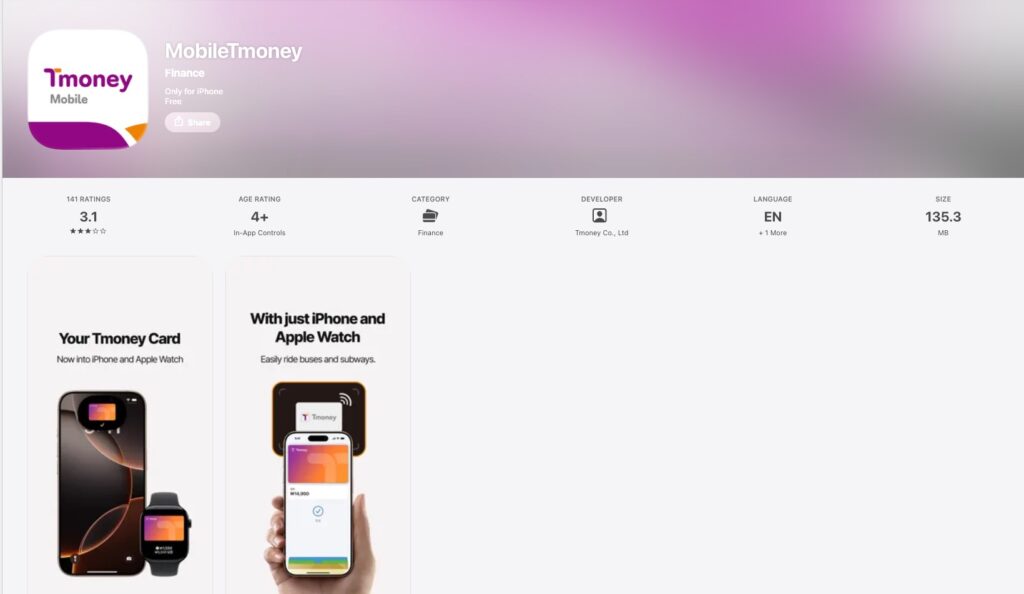
If you have an iPhone, there’s a third option that most guides don’t mention: digital T-money through Apple Pay. No physical card. No T-money account. No Hyundai Card required. It works for foreign tourists and overseas Koreans alike.
The short answer: yes, you can set up a fully functional T-money card on your iPhone in about five minutes, using a free app. Here’s exactly how.
What You Need
- An iPhone (any model with Apple Pay and NFC)
- The Mobile T-money app — free on the App Store
That’s it. No Korean phone number, no Korean bank account, no membership registration required.
Step-by-Step Setup
Step 1: Download the Mobile T-money app
Search for “Mobile T-money” or “티머니 모바일” on the App Store. Download and open it.
Step 2: Tap “둘러보기” (Browse), not Start
When the app opens, you’ll see a “Start” or login screen. Do not tap Start. Look for the “둘러보기” button underneath — this means “Browse” or “Look Around.” Tap that instead.
This is the key step. Tapping Browse skips the login entirely and takes you directly to the main screen without creating an account.
Step 3: Tap “Add to Apple Wallet”
On the main screen, you’ll see a large button in the centre: “Add to Apple Wallet”. Tap it, then agree to the terms when prompted.
Step 4: Complete the Apple Pay registration
Your iPhone will switch to the Apple Pay card registration screen. Tap Continue, and the card issuance process starts automatically. No manual input needed — just wait a moment.
Step 5: You’re done
A message confirming “Card Added” appears, and your T-money card is now in your Apple Wallet. You’ll also see it inside the Mobile T-money app.
Setting Up Express Transit (Recommended)
After the card is added, you’ll be prompted to set up Express Transit. Turn this on.
With Express Transit enabled, you don’t need to wake your iPhone, open the Wallet app, or authenticate with Face ID. Just hold your phone to the transit reader and it works instantly — exactly like tapping a physical card. This is the setting you want for a smooth experience at busy subway stations.
How to Top Up Your Apple Pay T-money
Subway station charging machines (most reliable)
Find a card charging machine at any Seoul subway station — they’re typically near the ticket gates. Place your iPhone on the card reader area. The machine will automatically detect your T-money card and prompt you to select a top-up amount. Choose your amount, insert cash (KRW), and wait a few seconds. Your iPhone will beep and show a confirmation when the top-up is complete.
Convenience stores (less reliable)
Top-ups at CU, GS25, and 7-Eleven are reportedly possible, but there are enough reports of failures online that I’d recommend sticking to subway station machines. If the convenience store method works for you, great. If not, head to the nearest station.
💡 Top-up tip: Start with 10,000–20,000 KRW (≈ USD $7–14). You can always add more at any station.
Important Limitations
⚠️ Apple Pay T-money does not work with the Climate Card or K-Pass. It functions as a standard pay-per-ride T-money only. If you want unlimited rides, you still need a physical Climate Card.
⚠️ The AREX airport train works with Apple Pay T-money — tap your iPhone at the gate just like a physical card.
Who Should Use Apple Pay T-money?
This option is ideal if you want to travel completely card-free, or if you’re arriving without time to visit a convenience store. It’s also a great backup option if your physical T-money card gets lost.
The one limitation worth knowing: no Climate Card benefit. If you’re doing 3+ days of heavy sightseeing, you’ll still want a physical Climate Card for unlimited rides — and you’ll need your T-money (or Apple Pay T-money) for the airport run regardless.
T-money vs Climate Card: Which One Is Right For You?
| T-money | Climate Card | WOWPASS | Apple Pay T-money | |
|---|---|---|---|---|
| Best for | Airport arrival + general use | 3+ days of city sightseeing | Foreign visitors who want one card for everything | iPhone users, card-free travel |
| Where to get | Incheon Airport convenience stores | Subway info offices / city convenience stores | wowpass.io (pre-order) or 379 kiosks | Mobile T-money app (free) |
| Card cost | 2,500–3,000 KRW (≈ USD $1.80–2.15) | 3,000 KRW (≈ USD $2.15) | 4,500 KRW (≈ USD $3.20) | Free |
| How you pay | Per ride | Fixed period (1–7 days) | Per ride (transit) + debit for shopping | Per ride |
| Top-up currency | KRW cash only | KRW cash only | 16 currencies or foreign credit card | KRW cash (subway machine) |
| Debit / shopping use | ❌ | ❌ | ✅ (Mastercard/Visa) | ❌ |
| Balance check app | ❌ | ❌ | ✅ | Via Apple Wallet |
| Passport needed | ❌ | ❌ | ✅ | ❌ |
| AREX airport train | ✅ | ❌ | ✅ | ✅ |
| Outside Seoul | ✅ Generally | ⚠️ Extra fare | ✅ Generally | ✅ Generally |
| Climate Card / K-Pass | N/A | ✅ This IS it | ❌ | ❌ |
My Recommendation by Trip Type
Best for first-timers (1–2 day visit): T-money only. Buy it at the airport, top up 20,000 KRW (≈ USD $14.30), and you won’t have to think about transit again. iPhone users can skip the physical card entirely and use Apple Pay T-money instead.
Best for 3–5 day city trip: T-money from the airport, then swap to a 3-day or 5-day Climate Card once you’re checked in. Use T-money for any trips outside the city.
Best for 7+ day stay: T-money + a 7-day Climate Card. The math works out clearly.
Best for iPhone users who hate carrying cards: Set up Apple Pay T-money before you land (or at the airport on Wi-Fi), top up at the first subway station machine, and you’re sorted.
Best for visitors who want to avoid cash entirely: WOWPASS. Pre-order online, pick up at the airport kiosk, charge it with your foreign credit card, and you’re set for both transit and everyday spending. Just remember to charge the T-money transit function separately from your main balance.
💡 Insider tip: Keep your T-money card even after you pick up a Climate Card. You’ll need it for the airport ride home — the Climate Card won’t work on the AREX. Same applies to Apple Pay T-money: it works on AREX, so it’s a solid backup even if you have a Climate Card.
Mistakes to Avoid
1. Arriving with no cash.
Both cards require Korean Won to buy and top up. Airport currency exchange isn’t glamorous, but it’s convenient — and you only need 30,000–50,000 KRW (≈ USD $21–36) to get started. Sort it before you leave the arrivals area.
2. Buying a single-use subway ticket instead of a T-money card.
Single-use tickets have a 500 KRW deposit you have to reclaim at a machine. They also don’t work on buses. Just get T-money — it takes 60 seconds.
3. Using the Climate Card on the AREX train.
It won’t work. The airport railroad is a separate service. Keep your T-money card in your wallet for the trip back to Incheon.
4. Forgetting to tap out.
Two consecutive missed tap-outs and your Climate Card is frozen for 24 hours. It’s surprisingly easy to do when you’re jet-lagged. Tap out. Every time.
5. Heading to Gyeonggi-do and expecting unlimited.
The Climate Card covers Seoul. If you’re going to Everland, Suwon, or other areas in Gyeonggi-do province, you’ll be charged extra. Check the destination zone before assuming it’s covered.
6. Sharing one card between two people — especially with kids.
T-money is one card, one person. You cannot tap two people through with one card. More importantly for families: if you use your adult card to pay for your child’s fare on a multi-leg bus-subway journey, the transfer discount breaks entirely. Every person in your group — including children — needs their own individual card. Children’s cards are the same price as adult cards (2,500 KRW / ≈ USD $1.80) and the discount is registered in two minutes at any convenience store.
7. Loading WOWPASS but forgetting to charge the transit function.
WOWPASS has two separate balances: your debit/spending balance and your T-money transit balance. Topping up the card at the kiosk with your credit card loads the debit side. The transit side needs to be charged separately — at the kiosk or a subway machine. This catches a lot of people right at the gate on their first ride.
8. Running out of balance at the gate.
If your T-money balance drops below the minimum fare, the turnstile will block you. It happens fast, especially if you’re moving around a lot. Top up before you’re empty — not after you’re stuck. Convenience stores can also refund any remaining balance if you’re leaving Korea (some conditions apply).
8. Expecting Apple Pay T-money to work with the Climate Card.
Apple Pay T-money functions as a standard pay-per-ride T-money card — it does not unlock the Climate Card’s unlimited-ride benefit. If you want unlimited trips, you need a physical Climate Card. iPhone + Apple Pay T-money is great for flexibility, but it’s not a shortcut to unlimited riding.
Practical Things to Know Before You Go
How much cash should I bring?
For transit alone: 30,000–50,000 KRW (≈ USD $21–36) covers most people for 3–4 days. That includes your card purchase, initial top-up, and a few extra trips.
Can I use Apple Pay on Seoul transit?
Yes — but not directly at the gate. The way it works is: you set up a T-money card inside Apple Wallet using the free Mobile T-money app. Once set up, you tap your iPhone at the transit reader just like a physical card. It’s quick, free to set up, and doesn’t require a Korean bank account or membership. See the full setup guide above. Note that this only works for iPhone users — Android users should stick with a physical T-money card.
💡 If you’re travelling with a Wise card or similar multi-currency card, you’ll have no problem withdrawing KRW from an ATM in the arrival hall. Here’s how we use Wise to avoid foreign transaction fees while travelling.
What if I have leftover credit on my T-money card?
You can use it next trip, refund it at a convenience store (for balances under a certain threshold), or keep it for future visits. It doesn’t expire quickly.
Is the AREX (airport train) worth it?
Yes — it’s fast, clean, and cheap compared to a taxi. The regular AREX stops at several stations before Seoul Station; the express goes direct. Both work with T-money.
FAQ
Is T-money card worth getting for a 2-day Seoul trip?
Yes. T-money is worth getting for even a single day in Seoul. The card costs around 3,000 KRW (≈ USD $2.15) and pays for itself on your first few subway rides. It also works on buses and taxis, which single-use tickets don’t. Buy one at the airport — it’s the single most useful thing you can do before leaving the arrivals hall.
Can I use a Seoul transit card outside the city?
T-money works across most of South Korea, including buses and subways in other cities. The Climate Card is different — it only covers Seoul’s transit network, and you may be charged extra if you travel to Gyeonggi-do areas like Suwon or Everland. If you’re planning day trips outside Seoul, keep your T-money as backup.
Does the Climate Card work on the AREX airport train?
No. The Climate Card does not cover the Airport Railroad Express (AREX). You’ll need a T-money card or a single-use ticket for your airport train journey. This is the most common mistake I see — people load up a Climate Card, then get to the airport gates with nothing that works. Keep your T-money card for the airport.
How much does a week of Seoul transit actually cost?
A 7-day Climate Card costs 20,000 KRW (≈ USD $14.30). At 4–5 subway and bus trips per day, that’s roughly 28–35 rides — each ride at about USD $0.40. For comparison, a single London Underground journey costs around USD $4–6. Seoul’s transit is genuinely one of the best deals in any major city in the world.
What happens if I forget to tap out with the Climate Card?
If you miss tapping out two consecutive times, your Climate Card gets suspended for 24 hours. You won’t be able to use it during that period. If it happens, use your T-money card as backup while you wait for the suspension to lift. It’s an annoying rule, but it’s consistent — so just make tapping out a habit.
Where do I buy a T-money card if I’m not arriving at Incheon Airport?
T-money cards are sold at nearly every CU, GS25, 7-Eleven, and emart24 convenience store across South Korea — including inside Seoul. You can also buy them at subway station information desks. If you’re arriving at Gimpo Airport or by train, you’ll have no trouble finding one nearby.
Do children need their own T-money card in Seoul?
Yes. Every child needs their own individual T-money card — you cannot pay for a child using an adult’s card, and attempting to do so will break the transfer discount on multi-leg journeys. Children aged 6–12 get a children’s fare, and teens aged 13–18 get a youth fare. To activate the discount, register your child’s date of birth at a convenience store counter (tell the staff the birthdate — no documents needed, applies instantly). Cards bought from subway vending machines must be registered online within 10 days or they revert to adult fare.
What is WOWPASS and is it worth getting for a Seoul trip?
WOWPASS is a prepaid card with a built-in T-money transit function, designed specifically for foreign visitors in Korea. It’s worth it if you want to avoid cash exchange entirely — you can top it up with 16 different foreign currencies or a credit card at any of 379 kiosks nationwide. It also works as a debit card for shopping and restaurants. The card costs 4,500 KRW (≈ USD $3.20) and requires a passport. One important thing: the T-money transit balance and the main debit balance are separate — you need to charge the transit side explicitly before using it on the subway.
Can I use Apple Pay T-money on the Seoul subway without a Korean bank account?
Yes. Apple Pay T-money works without a Korean bank account, phone number, or T-money membership. Download the free Mobile T-money app, tap “Browse” (둘러보기) to skip the login screen, then tap the “Add to Apple Wallet” button on the main screen. The card is issued automatically in minutes. You can top up with cash at any subway station charging machine. This works for foreign tourists and overseas Koreans alike.
Related Guides
Sorting your transit card is just one piece of the budget puzzle. Here’s what else is worth reading before you go:
- Wise Card vs. Traditional Travel Cards: Which One Actually Saves You More? — because getting KRW without losing money to fees matters
- Incognito Mode for Cheaper Hotel Deals: Does It Actually Work? — a quick read before you book your Seoul accommodation
(Korea itinerary guide — coming soon)
Final Word
Seoul’s public transit is, without exaggeration, one of the best systems in the world — clean, frequent, cheap, and easy to navigate once you have the right card. The hardest part is just knowing which one to grab first, and now you do.
T-money at the airport. Climate Card if you’re staying a few days. iPhone? Set up Apple Pay T-money before you even land. Keep both T-money and Climate Card if you’re going anywhere outside Seoul — one for unlimited city rides, one for everything else.
If you’ve got questions about getting around Seoul, drop them in the comments below. I check it regularly and I’ll actually answer.
Prices verified May 2026. Exchange rate used: 1 USD ≈ 1,400 KRW. Always check current rates before you travel.